

Forging the Future: How AI Voice Automation is Revolutionizing Manufacturing and Industrial B2B Sales
Introduction: The Complex World of Industrial Sales
The manufacturing and industrial B2B sector is the backbone of the global economy, a world of complex machinery, intricate supply chains, and high-value, long-term relationships. The sales process in this industry is a far cry from a simple transactional sale. It is a consultative, multi-stage journey that requires deep technical knowledge, a thorough understanding of the customer’s business, and a high degree of trust. This chapter explores how AI voice automation is emerging as a powerful catalyst for change in the manufacturing and industrial sector, helping companies to navigate the complexities of the B2B sales cycle, build stronger relationships with their customers, and forge a more efficient and profitable future.
Section 1: The State of Manufacturing and Industrial B2B Sales: A World of Precision and Pressure
The manufacturing and industrial sector is undergoing a profound transformation, driven by globalization, technological advancements, and the rise of Industry 4.0. In this environment, the sales process is more critical and more challenging than ever before.
The Industrial B2B Sales Cycle: A Marathon, Not a Sprint
The industrial B2B sales cycle is notoriously long and complex. The key stages and their associated challenges include:
- Lead Generation and Prospecting: Identifying and reaching the right decision-makers within a large industrial organization can be a major challenge. This often involves a combination of inbound marketing, outbound prospecting, and trade show participation.
- Technical Qualification: Before a sale can be made, the sales team must first understand the customer’s technical requirements and determine if their product is a good fit. This often requires a deep level of technical expertise.
- Solution Design and Proposal: Based on the customer’s requirements, the sales team will design a solution and develop a detailed proposal. This can be a time-consuming and resource-intensive process.
- Negotiation and Closing: The negotiation process in industrial B2B sales can be long and complex, involving multiple stakeholders and a high degree of scrutiny.
The Pain Points of the Modern Industrial Sales Team
- The Long Sales Cycle: The long sales cycle in industrial B2B can be a major drain on resources. It can take months, or even years, to close a deal, and there is no guarantee of success.
- The Challenge of Technical Qualification: If a lead is not properly qualified from a technical perspective, a significant amount of time and resources can be wasted on a deal that was never going to close.
- The Global Nature of the Business: Many manufacturing and industrial companies operate on a global scale. This can create challenges in terms of coordinating across time zones, managing different languages and cultures, and navigating complex international regulations.
- The Need for a Consultative Approach: In industrial B2B sales, the sales team is not just selling a product; they are selling a solution. This requires a consultative approach, where the sales team acts as a trusted advisor to the customer.
Section 2: The Transformative Power of AI Voice Automation in Manufacturing and Industrial B2B
AI voice automation is providing a powerful solution to the challenges that have long plagued the manufacturing and industrial B2B sales process. By automating many of the administrative and repetitive tasks that are currently handled by human sales reps, AI can help them to be more efficient, more effective, and more strategic.
How AI Voice Automation Works in an Industrial B2B Setting
AI voice automation platforms can be integrated with a company’s existing CRM and ERP systems. The AI agents can be programmed to:
- Qualify Leads: The AI agent can handle inbound inquiries and ask a series of qualifying questions to determine if the lead is a good fit from both a commercial and a technical perspective.
- Schedule Technical Consultations: The AI agent can access the calendars of the company’s technical experts and schedule initial consultations in real-time.
- Nurture Leads: The AI agent can nurture leads over the long sales cycle, providing them with relevant information and keeping them engaged until they are ready to buy.
- Provide Post-Sale Support: The AI agent can provide basic post-sale support, such as answering frequently asked questions and providing order status updates.
The ROI of AI Voice Automation in Manufacturing and Industrial B2B
The ROI of AI voice automation in the manufacturing and industrial B2B sector can be significant. By automating the top of the sales funnel, companies can:
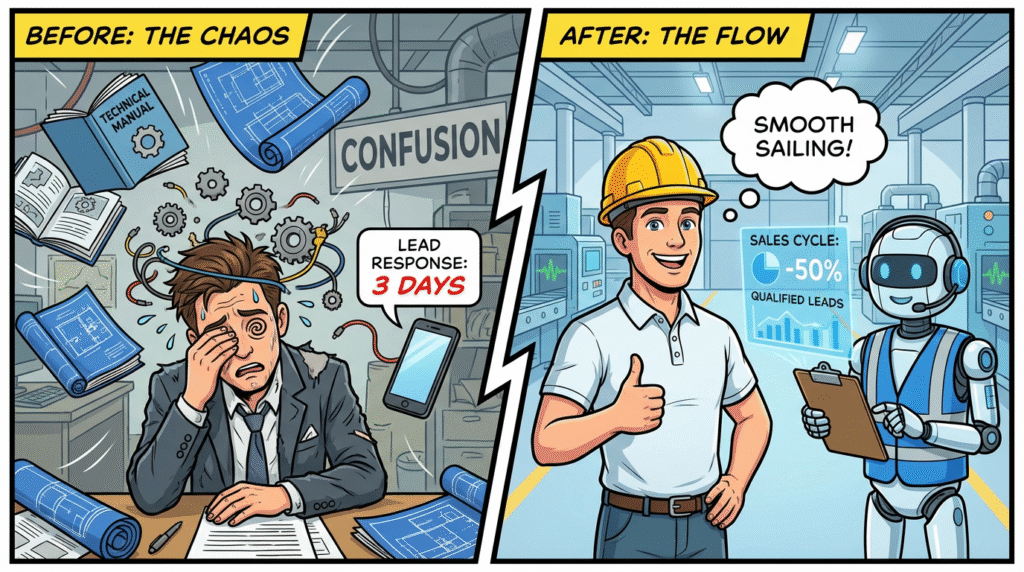
- Shorten the Sales Cycle: By quickly qualifying leads and scheduling technical consultations, AI can help to move deals through the pipeline faster.
- Increase Sales Productivity: By freeing up sales reps from administrative tasks, they can focus on what they do best: building relationships and closing deals.
- Improve Lead Quality: By asking a series of qualifying questions, the AI agent can ensure that the sales team is only spending their time on high-quality leads.
- Enhance the Customer Experience: A seamless and professional communication process can create a positive impression and set the stage for a long-term relationship.
Section 3: The Competitive Landscape: How Industrial Leaders are Embracing AI
The manufacturing and industrial sector has a reputation for being slow to adopt new technologies, but that is changing. A new generation of forward-thinking companies is embracing AI to gain a competitive edge.
- Siemens: The German industrial giant has been a pioneer in the adoption of digital technologies. They are using AI to optimize their manufacturing processes, improve their supply chain, and provide their customers with more predictive and proactive service.
- General Electric: The American multinational conglomerate has invested heavily in its Predix platform, which is an industrial internet of things (IIoT) platform that uses AI to analyze data from industrial machines and provide insights for predictive maintenance and operational efficiency.
- Caterpillar: The world’s largest construction equipment manufacturer is using AI to provide its customers with a more personalized and proactive service experience. Their Cat Asset Intelligence platform uses AI to monitor the health of their equipment and to predict when maintenance is needed.
Section 4: Your Implementation Roadmap: A Practical Guide to AI Adoption
For manufacturing and industrial B2B companies, the implementation of AI voice automation should be a strategic and well-planned process. Here is a four-step roadmap to guide you:
- Integrate with Your Existing Systems: The first step is to choose an AI voice automation platform that can be seamlessly integrated with your existing CRM and ERP systems. This will ensure a smooth workflow and provide the AI agent with the information it needs to be effective.
- Focus on a Specific Product Line or Business Unit: It is often best to start with a specific product line or business unit. This will allow you to test the platform and demonstrate its value before rolling it out to the entire organization.
- Develop a Comprehensive Knowledge Base: The AI agent is only as smart as the information it has access to. It is critical to develop a comprehensive knowledge base that includes technical specifications, pricing information, and answers to frequently asked questions.
- Train Your Sales Team to Work with the AI Agent: The AI agent is not a replacement for your sales team; it is a tool to help them be more effective. It is important to train your sales team on how to work with the AI agent and how to leverage the information it provides.
Section 5: The Future of Industrial B2B Sales: The Smart Factory Meets the Smart Sales Team
The future of industrial B2B sales is a world where the smart factory is seamlessly connected to the smart sales team. In this future, AI will provide the sales team with real-time insights into the customer’s needs and the factory’s capabilities. This will enable a level of customization and responsiveness that is not possible today.
Conclusion: Building the Future, One Conversation at a Time
The manufacturing and industrial B2B sector is at the forefront of a new industrial revolution. The companies that can successfully leverage technology to transform their sales processes will be the ones that lead the way. AI voice automation is a powerful tool that can help you to do just that. By embracing this technology, you can build a more efficient, more effective, and more customer-centric sales organization, and forge a more profitable future for your business
