

The Billable Hour Breakthrough: How AI Voice Automation is Maximizing Profitability in Professional Services
Introduction: The Value of Time in Professional Services
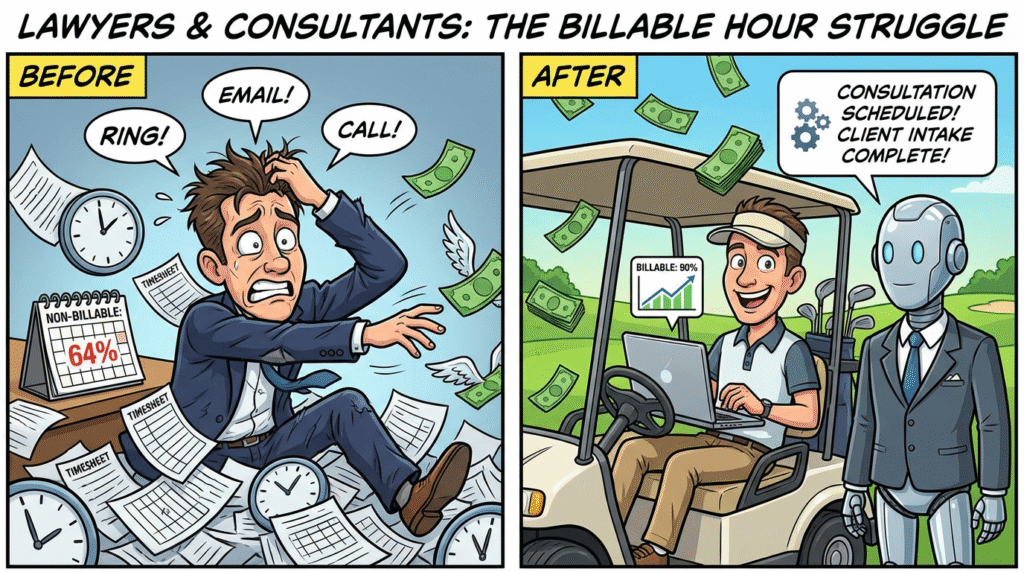
In the professional services sector—encompassing legal, consulting, and accounting firms—the old adage “time is money” is not just a saying; it is the fundamental business model. The billable hour is the core unit of value, and the efficient use of a professional’s time is directly proportional to the firm’s profitability. However, a significant portion of a professional’s day is often consumed by non-billable activities, such as business development, lead qualification, and appointment scheduling. This chapter explores how AI voice automation is providing a much-needed breakthrough for professional services firms, helping them to reclaim lost time, focus on high-value work, and build more profitable and sustainable businesses.
Section 1: The State of Professional Services Sales: A Balancing Act of Expertise and Efficiency
Professional services firms are in the business of selling expertise. The sales process is not about selling a product, but about selling the knowledge, skills, and experience of the firm’s professionals. This creates a unique set of challenges for business development.
The Professional Services Sales Cycle: A Journey of Credibility
The professional services sales cycle is a high-touch and relationship-driven process. The key stages and their associated challenges include:
- Lead Generation and Networking: Professionals generate leads through a variety of channels, including referrals, networking events, and thought leadership (e.g., writing articles, speaking at conferences). The challenge is to consistently generate a pipeline of qualified leads.
- Initial Consultation: The initial consultation is the most critical stage of the sales process. This is where the professional has the opportunity to demonstrate their expertise, understand the client’s needs, and build credibility. However, a significant amount of time can be wasted on consultations with unqualified prospects.
- Proposal and Engagement Letter: Based on the initial consultation, the professional will develop a proposal and engagement letter. This can be a time-consuming process that requires a deep understanding of the client’s business and legal or financial situation.
- Client Onboarding: Once the engagement letter is signed, the client must be onboarded. This can involve a significant amount of administrative work, such as setting up the client in the firm’s systems and collecting necessary documentation.
The Pain Points of the Modern Professional
- The Tyranny of the Non-Billable Hour: Every hour spent on administrative tasks is an hour that cannot be billed to a client. The constant pressure to maximize billable hours can lead to burnout and a poor work-life balance.
- The Challenge of Lead Qualification: It can be difficult to determine which prospects are serious and which are simply “shopping around.” Wasting time on unqualified leads is a major drain on productivity.
- The Scheduling Nightmare: Coordinating the schedules of multiple partners and clients can be a logistical nightmare. The back-and-forth of scheduling can be a major source of frustration and inefficiency.
- The Need to Demonstrate Value: In a competitive market, it is not enough to simply be an expert. Professionals must also be able to effectively communicate their value proposition and differentiate themselves from the competition.
Section 2: The Transformative Power of AI Voice Automation in Professional Services
AI voice automation is offering a powerful solution to the productivity challenges that have long plagued the professional services industry. By automating many of the administrative and repetitive tasks that are currently handled by human professionals, AI can help them to focus on what they do best: providing expert advice and serving their clients.
How AI Voice Automation Works in a Professional Services Setting
AI voice automation platforms can be integrated with a firm’s existing CRM and practice management systems. The AI agents can be programmed to:
- Qualify Leads: The AI agent can handle inbound inquiries and ask a series of qualifying questions to determine if the prospect is a good fit for the firm’s services.
- Schedule Consultations: The AI agent can access the calendars of the firm’s professionals and schedule initial consultations in real-time.
- Send Reminders: The AI agent can send automated reminders to both the professional and the client before a consultation to reduce the likelihood of a no-show.
- Handle Client Intake: The AI agent can collect basic information from new clients and guide them through the initial stages of the onboarding process.
The ROI of AI Voice Automation in Professional Services
The ROI of AI voice automation in the professional services industry can be measured in terms of both time and money. By automating the top of the sales funnel, firms can:
- Increase Billable Hours: By freeing up professionals from administrative tasks, they can spend more time on billable work.
- Improve Lead Conversion Rates: Instant follow-up and efficient scheduling can lead to a significant increase in the number of leads that convert into clients.
- Enhance the Client Experience: A seamless and professional communication process can create a positive first impression and set the stage for a long-term relationship.
- Reduce Administrative Costs: By automating tasks that are currently handled by administrative staff, firms can reduce their overhead costs.
Section 3: The Competitive Landscape: How Professional Services Innovators are Embracing AI
The professional services industry has traditionally been slow to adopt new technologies, but that is changing. A new generation of forward-thinking firms is embracing AI to gain a competitive edge.
- Atrium: The legal technology company, founded by Justin Kan (the co-founder of Twitch), was a pioneer in using technology to streamline the delivery of legal services. While the company ultimately shut down, it was a bold experiment in reimagining the traditional law firm model.
- Deloitte: The global consulting giant has invested heavily in AI and automation. They are using AI to analyze vast amounts of data to provide their clients with more insightful and data-driven advice.
- KPMG: The accounting and advisory firm has developed a portfolio of AI-powered tools to help their clients with everything from tax compliance to risk management.
Section 4: Your Implementation Roadmap: A Strategic Approach to AI Adoption
For professional services firms, the implementation of AI voice automation should be a strategic and well-planned process. Here is a four-step roadmap to guide you:
- Calculate the Cost of Your Non-Billable Time: The first step is to understand the true cost of your non-billable time. Track the amount of time that your professionals are spending on administrative tasks and calculate the potential revenue that is being lost.
- Start with a Single Practice Group: It is often best to start with a single practice group or service line. This will allow you to test the platform and demonstrate its value before rolling it out to the entire firm.
- Ensure a Seamless Handoff to a Human: The AI agent should be designed to handle the initial stages of the client intake and scheduling process. However, it is critical to ensure a seamless handoff to a human professional for the actual consultation. The AI should augment the human, not replace them.
- Communicate the Value to Your Team: The successful adoption of AI requires buy-in from your team. Communicate the value of the platform in terms of how it will help them to be more efficient, more effective, and more successful.
Section 5: The Future of Professional Services: The Augmented Professional
The future of professional services is not about replacing human professionals with robots. It is about creating the “augmented professional”—a human expert who is empowered by the power of AI. In this future, AI will handle the administrative and repetitive tasks, freeing up the professional to focus on the high-value, strategic, and relationship-driven aspects of their work.
Conclusion: The Ultimate Competitive Advantage
In the professional services industry, time is the ultimate competitive advantage. The firms that can most effectively leverage technology to maximize the value of their professionals’ time will be the ones that succeed in the years to come. AI voice automation is a powerful tool that can help you to do just that. By embracing this technology, you can build a more profitable, more efficient, and more client-focused firm
