
The SaaS Sales Revolution: How AI Voice Automation is Redefining Growth in the Technology Sector
Introduction: The High-Stakes World of SaaS Sales
The Software-as-a-Service (SaaS) and technology industry is the engine of modern innovation, characterized by rapid growth, fierce competition, and a relentless pace of change. In this high-stakes environment, the sales process is not just a function; it is the lifeblood of the organization. The ability to efficiently and effectively convert leads into paying customers is what separates the market leaders from the laggards. However, the traditional SaaS sales model is fraught with challenges, from the high cost of customer acquisition to the ever-present problem of demo no-shows. This chapter explores how AI voice automation is emerging as a transformative force in the SaaS and technology sector, offering a powerful solution to these long-standing challenges and redefining what it means to sell software in the digital age.
Section 1: The State of SaaS Sales: A Landscape of Opportunity and Challenge
The SaaS market is a global powerhouse, with projected revenues expected to reach over $1 trillion by 2026 [1]. This explosive growth has created a hyper-competitive landscape, where thousands of companies are vying for the attention of a finite pool of customers. The pressure to acquire new customers and grow revenue is immense, and the sales team is on the front lines of this battle.
The SaaS Sales Funnel: A Leaky Bucket
The typical SaaS sales funnel is a multi-stage process that begins with lead generation and culminates in a closed deal. However, this funnel is often a “leaky bucket,” with a significant number of leads dropping off at each stage. The key stages and their associated challenges include:
- Lead Generation: SaaS companies generate leads through a variety of channels, including content marketing, paid advertising, and events. The challenge is not just the quantity of leads, but the quality. A high volume of unqualified leads can overwhelm the sales team and waste valuable resources.
- Lead Qualification: Once a lead is generated, it must be qualified to determine if it is a good fit for the product. This is typically done by a Sales Development Representative (SDR), who engages with the lead to understand their needs, budget, and timeline. This is a time-consuming and often repetitive process.
- Demo/Trial: For most SaaS products, the demo is the most critical stage of the sales process. This is where the sales team has the opportunity to showcase the value of the product and answer the prospect’s questions. However, getting a prospect to commit to a demo, and then actually show up for it, is a major challenge.
- Closing: If the demo is successful, the sales team will work to close the deal. This can involve contract negotiations, security reviews, and legal approvals.
The Pain Points of the Modern SaaS Sales Team
- The High Cost of Customer Acquisition (CAC): Acquiring new customers is expensive. The cost of an SDR, marketing campaigns, and sales commissions can quickly add up. In a competitive market, CAC can be a major drain on profitability.
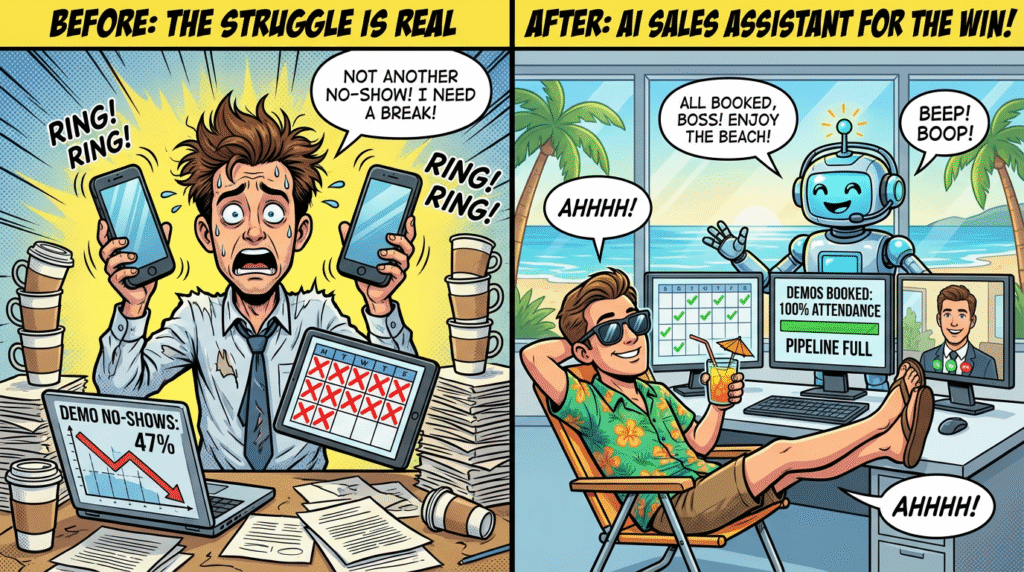
- The Plague of Demo No-Shows: A demo no-show is one of the most frustrating and costly problems in SaaS sales. When a prospect books a demo but fails to show up, it not only wastes the time of the sales rep but also represents a lost opportunity.
- The Challenge of Scaling the SDR Team: As a SaaS company grows, it needs to scale its sales team. However, hiring, training, and retaining a team of SDRs is a significant investment. It can also be difficult to maintain quality and consistency as the team grows.
- The Inefficiency of Manual Processes: Many SaaS sales teams are still reliant on manual processes for lead qualification, appointment setting, and follow-up. This is not only inefficient but also prone to human error.
Section 2: The Transformative Power of AI Voice Automation in SaaS Sales
AI voice automation is emerging as a game-changer for SaaS sales teams, offering a powerful solution to the challenges outlined above. By leveraging AI-powered voice agents, SaaS companies can automate many of the time-consuming and repetitive tasks that are currently handled by human SDRs, freeing them up to focus on higher-value activities.
How AI Voice Automation Works
AI voice automation platforms, such as Salio.AI, use advanced natural language processing and text-to-speech technology to create AI voice agents that can engage in human-like phone conversations. These agents can be programmed to:
- Qualify Leads: The AI agent can call a new lead within seconds of them filling out a form on the website. It can ask a series of qualifying questions to determine if the lead is a good fit for the product.
- Book Demos: If the lead is qualified, the AI agent can access the sales team’s calendar and book a demo in real-time.
- Send Reminders: The AI agent can send automated reminders to the prospect before the demo to reduce the likelihood of a no-show.
- Handle Objections: The AI agent can be trained to handle common objections and answer frequently asked questions.
The ROI of AI Voice Automation in SaaS
The return on investment (ROI) of AI voice automation in the SaaS industry can be significant. By automating the top of the sales funnel, SaaS companies can:
- Reduce CAC: By automating the work of an SDR, companies can significantly reduce their customer acquisition costs.
- Increase Demo Attendance: Automated reminders and instant follow-up can dramatically reduce the number of demo no-shows.
- Improve SDR Productivity: By freeing up SDRs from the drudgery of cold calling and appointment setting, they can focus on more strategic activities, such as building relationships with key accounts.
- Scale on Demand: AI voice agents can be scaled up or down as needed, providing a level of flexibility that is not possible with a human sales team.
Section 3: The Competitive Landscape: How SaaS Leaders are Leveraging AI
The adoption of AI in SaaS sales is not just a trend; it is a competitive necessity. The companies that are embracing AI are pulling away from the competition, and the gap is only going to widen. Here’s how some of the leading SaaS companies are using AI to gain a competitive edge:
- Salesforce: The CRM giant has invested heavily in its Einstein AI platform, which provides a wide range of AI-powered features, including predictive lead scoring, opportunity insights, and automated activity capture.
- HubSpot: The inbound marketing and sales platform has integrated AI into its platform to provide features such as predictive lead scoring, AI-powered email templates, and a free chatbot builder.
- Outreach: The sales engagement platform uses AI to analyze sales conversations and provide real-time coaching to sales reps. Its “Kaia” AI assistant can join live calls to help reps with objections and provide them with the information they need to close the deal.
Section 4: Your Implementation Roadmap: Getting Started with AI Voice Automation
Implementing AI voice automation in your SaaS sales process does not have to be a complex or daunting task. Here is a simple, four-step roadmap to get you started:
- Identify Your Use Case: The first step is to identify the specific pain point that you want to solve. Are you struggling with demo no-shows? Is your SDR team overwhelmed with unqualified leads? By focusing on a specific use case, you can ensure a successful implementation.
- Choose the Right Platform: There are a growing number of AI voice automation platforms on the market. When choosing a platform, it is important to consider factors such as the quality of the AI voice, the ease of integration with your existing CRM, and the level of customer support.
- Start Small and Iterate: It is often best to start with a small pilot project. This will allow you to test the platform and refine your process before rolling it out to the entire sales team.
- Measure and Optimize: Once you have implemented the platform, it is important to track your results and make adjustments as needed. By continuously measuring and optimizing your process, you can ensure that you are getting the most out of your investment.
Section 5: The Future of SaaS Sales: What’s Next?
The AI revolution in SaaS sales is just getting started. As the technology continues to evolve, we can expect to see even more sophisticated and powerful AI-powered sales tools. Some of the key trends to watch include:
- Hyper-Personalization: AI will enable a level of personalization that is not possible today. AI agents will be able to analyze a prospect’s data in real-time to deliver a highly personalized and relevant message.
- Autonomous Sales Agents: The concept of the “digital worker” will become a reality. We will see the emergence of autonomous AI sales agents that can handle the entire sales process, from lead generation to closing.
- The Convergence of AI and Human Intelligence: The future of sales is not about replacing humans with AI. It is about augmenting human intelligence with the power of AI. The most successful sales teams will be those that can effectively combine the strengths of both.
Conclusion: The Time to Act is Now
The SaaS and technology industry is at a crossroads. The old way of selling is no longer sustainable. The companies that embrace AI and automate their sales processes will be the ones that thrive in the years to come. The question is not whether you should adopt AI voice automation, but when. The future of SaaS sales is here, and the time to act is now.
