

AI Voice Bots Are Creating a New Global Accent
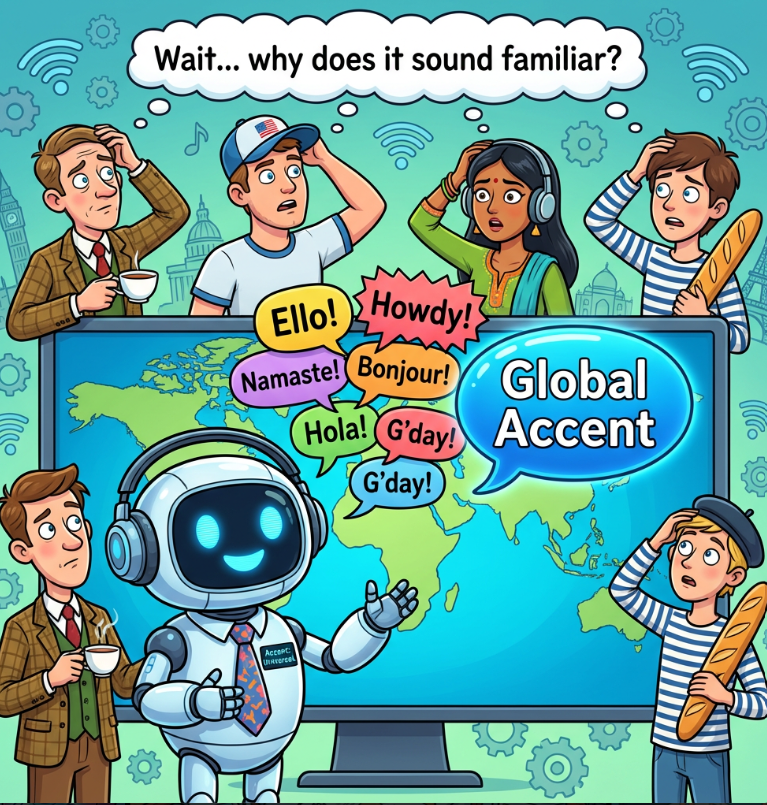
Some voices belong to a place — a city, a country, a neighborhood.
They carry spice, rhythm, personality. A touch of home.
Now imagine a voice that doesn’t belong to anywhere — yet feels familiar to everyone.
Across phones, screens, and smart devices, AI voice bots are doing something remarkable: they’re shaping a new kind of global accent — one that feels neutral, clear, efficient, and comfortably universal.
This is not just a technical evolution.
It’s a cultural phenomenon.
One voice at a time, from New York to Nairobi to New Delhi, AI is weaving a pattern of tone and cadence that is becoming the accent of tomorrow.
And it’s changing how we hear the world.
What Is the Global AI Voice Accent?
When you think of an accent, you imagine subtle traits:
- musical intonation
- rhythmic emphasis
- soft or sharp consonants
- stretched vowels or clipped phrases
Now imagine stripping away the regional markers — but keeping warmth, clarity, and approachability.
That’s the new global voice accent.
AI voice bots don’t mimic:
- a London lilt
- a Sydney drawl
- a Lagos bounce
- a Tokyo cadence
Instead, they build a fused accent — born from:
✔️ Educated speech patterns
✔️ Broad intelligibility
✔️ Calm, moderate pacing
✔️ Clarity above all
It’s neither British nor American, neither Indian nor Australian — yet it carries echoes of all of them.
A neutral, globally discernible rhythm that transcends borders.
Why This Accent Is Everywhere — and Growing
In the early days of voice technology, AI sounded robotic: flat, emotionless, rigid. But people didn’t embrace it. Not fully.
Humans want voices that feel:
- thoughtful
- alive
- present
So engineers began tuning voice bots not just for accuracy — but for emotional resonance. They didn’t want voices that just speak — they wanted voices that connect.
And the result?
Voices that:
- pause where a human pauses
- speak neither too fast nor too slow
- emphasize what matters
- sound like they know you’re listening
Over millions of interactions — in customer support, in devices, in apps — patterns emerge. And from those patterns, a new accent is being forged — one that doesn’t belong to any single nation, but feels comfortable to everyone.
How This New Accent Changes Interaction
When voice technology first appeared, it was all about understanding words.
Now it’s about understanding people.
A global AI voice accent:
🔹 Reduces misunderstandings
🔹 Improves clarity across cultures
🔹 Lowers cognitive load for listeners
🔹 Feels emotionally balanced
People don’t just hear the voice — they follow it.
This accent doesn’t shout.
It doesn’t rush.
It doesn’t overwhelm.
It invites you into the conversation.
That’s why people prefer it — consciously or not.
The Psychology Behind the Global Accent
Human brains are pattern detectors.
We recognize familiar speech.
We settle into it.
When voices carry:
- consistent rhythm
- measured pacing
- balanced tone
our brains relax.
We stop decoding how they speak and focus on what they’re saying.
This is exactly what the new AI accent accomplishes.
It doesn’t claim identity.
It creates inclusion.
And in a world where global communication is the norm — not the exception — that’s powerful.
Are We Losing Regional Flavor?
This is the part that surprises people:
A global AI accent doesn’t erase regional accents — it coexists with them.
It simply provides another option — a voice that:
✔️ feels familiar to many
✔️ avoids confusion
✔️ aids clarity
✔️ preserves emotional nuance
Think of it like a lingua franca — not imposed, but emerged through interaction.
People won’t stop speaking with their home accents. But when they engage with technology — with voice assistants, customer bots, service interactions — they will increasingly hear this new voice. Not out of necessity — but out of comfort.
A New Era of Voice Identity
Here’s the twist:
This accent wasn’t designed by any one person.
It wasn’t declared by a committee.
It emerged.
From millions of data points, user interactions, voice designs, emotional tuning algorithms — something beautifully organic is growing.
And as AI voice bots become woven into daily life — from education to support to entertainment — this accent will continue to evolve.
It will absorb influences.
It will become more expressive.
It will become more human.
But it will never be tied to just one place.
It will be global.
Why People Are Drawn to It
The new AI voice accent feels:
✨ Comfortable because it’s familiar
✨ Clear because it’s optimized
✨ Warm because it’s thoughtfully tuned
✨ Trustworthy because it sounds balanced
And in a world overloaded with noise and distraction, a voice that feels:
- calm
- clear
- and emotionally attuned
becomes not just useful — but desired.
People don’t just respond to words.
They respond to presence.
To cadence.
To tone.
And this new accent delivers all of that — without the friction of regional bias.
Final Thought: The Voice of Tomorrow Is Listening — And Speaking — for Everyone
Language has always evolved.
Accents shift with migration.
Dialects change with culture.
Slang comes and goes.
Now voice itself — not just the words — is evolving.
AI voice bots are not just tools.
They are cultural mirrors — reflecting patterns of speech that feel universal.
And the accent they are creating?
It’s an accent born not from geography —
but from connection.
From millions of conversations, all around the world.
A voice that doesn’t belong to one place —
but feels at home everywhere
