

AI Fixes Sales Pipeline Gaps Humans Ignore
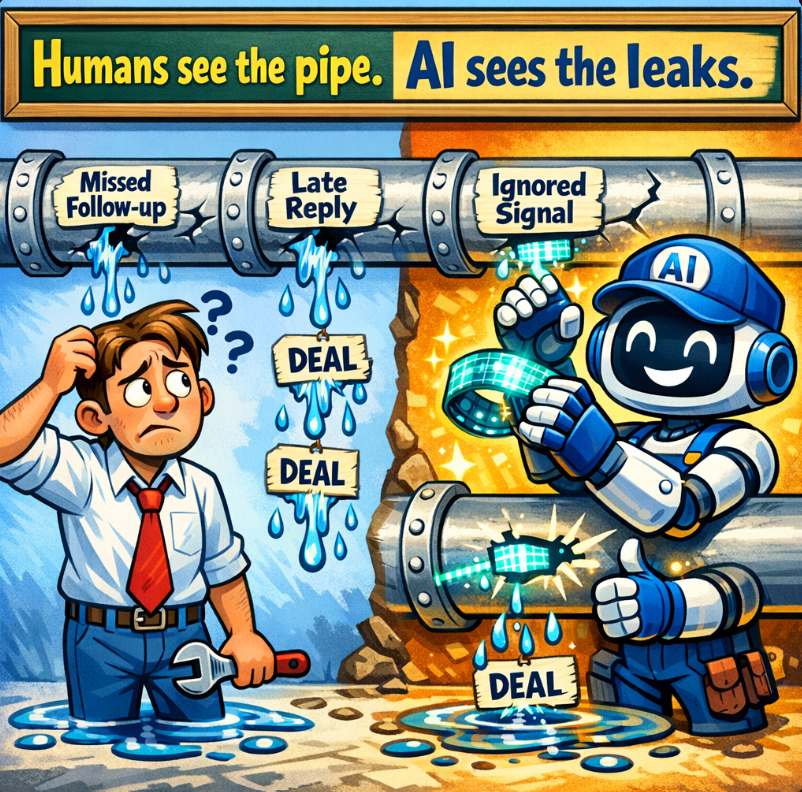
There’s a moment in every sales cycle where the connection starts to fade — not because the lead went cold, but because the human radar stopped scanning. A subtle hesitation. A skipped follow-up. A message left unsent. A pattern too quiet, too nuanced, too invisible to the human eye.
Sales teams misdiagnose these pipeline gaps all the time.
They blame macro trends, pricing resistance, or lead quality.
But the real culprit?
Human blind spots.
These are the tiny fractures in the pipeline — the barely-noticeable shifts — that silently bleed momentum.
And AI sees them.
The Blind Spots Humans Never Catch
Humans are brilliant at creativity, empathy, big-picture strategy, and relationship building.
But we’re not great at noticing:
- micro-moment shifts
- subtle hesitation patterns
- repeated partial engagements
- small behavioral digressions
- context changes hidden in indirect feedback
These are the cracks where deals leak energy, urgency dissolves, and enthusiasm quietly escapes.
Often, teams discover those gaps only after a deal fails — too late, with only speculation and retrospective analysis to explain what went wrong.
That’s because:
Humans interpret data at macro scale.
AI interprets data at every scale, simultaneously.
Why AI Sees What Humans Miss
Picture two salespeople listening to calls:
Salesperson A hears the words.
Salesperson B notices the tone.
Salesperson C picks up confidence cues.
Now imagine an AI that listens to:
- pause patterns
- tone shifts
- hesitation markers
- conversational detours
- timing fluctuations
- sentiment gradients
- linguistic subtlety
AI doesn’t just hear language.
It reads behavioral architecture.
That’s the key difference.
Humans listen.
AI interprets context in real time.
Detecting the Almost-Invisible Signals
Here are some pipeline gaps humans typically miss — but AI catches instantly:
1. Hesitation Cascades
A lead has begun hesitating over multiple touch points — not obvious enough to trigger an alert — but consistent.
AI flags rising hesitation signals long before the conversation goes cold.
2. Tone Drift
A buyer’s language subtly softens over time — fewer assertive phrases, more passive qualifiers.
Humans might miss it.
AI sees it like a shift in weather pattern.
3. Partial Engagement Clusters
A lead opens 90% of messages but never clicks the key CTA.
AI recognizes incomplete engagement signatures and triggers contextually timed actions.
4. Silent Overrides
The lead stops asking questions — not good news.
AI sees silence as a data point, not a neutral pause.
Humans perceive gaps as accidental.
AI interprets them as signals.
AI Doesn’t Wait for Failure — It Predicts It
Human teams usually intervene after the pipeline gap becomes visible.
AI intervenes before it becomes significant.
This is the seismic shift:
- Humans react.
- AI anticipates.
Before a human manager even notices the momentum fading, AI has already:
- rerouted engagement strategies
- suggested empathetic messaging
- optimized follow-up timing
- adjusted prioritization
- elevated the lead to human reps with context
And all without forcing a crisis.
This isn’t magic.
This is pre-emptive insight.
Context Is What Makes AI Powerful — Not Just Data
AI doesn’t just see numbers.
AI sees patterns in behavior over context.
That’s why it doesn’t just trigger alerts.
It interprets meaning.
A lead may:
- read a message but not reply
- pause before answering a question
- switch from specific to general phrasing
- slow response time
- increase use of tentative language
Humans notice the symptom after it becomes disruptive.
AI feels the symptom while it’s still a whisper.
That’s not analysis.
That’s anticipation.
AI Doesn’t Replace Salespeople — It Complements Them
This is crucial.
AI doesn’t take over interactions.
It enriches them.
Instead of:
- cold automation
- robotic sequences
- rigid scripts
- generic triggers
Here’s what AI does:
- captures emotional drift
- reads conversational micro-signals
- recommends personalized interventions
- prioritizes leads based on nuanced engagement
- equips human reps with context before they even speak
AI doesn’t replace empathy.
It amplifies human intention.
Humans bring heart.
AI brings precision.
Together, they fill gaps no one could see alone.
When AI Alerts — Humans Connect
Imagine this:
A buyer has gone quiet.
A human rep sees silence.
They wonder, “Did I lose them?”
AI sees:
- gradual hesitation
- declining tonal confidence
- reduced responsiveness
- segment engagement drop
AI alerts the rep before silence becomes abandonment.
The human rep steps in — not to salvage — but to connect with purpose.
That’s the real power:
AI doesn’t just notify.
It enables meaningful intervention.
The Hidden Cost of Ignoring AI Insights
When companies rely on intuition alone, they pay in:
- stalled pipelines
- unnoticed disengagement
- reactive firefighting
- misinterpreted intention
- delayed action
- lost opportunities
Those costs aren’t obvious.
They’re emotional, psychological, hidden.
AI makes the invisible visible.
What was once noise becomes clarity
The Big Takeaway
Humans interpret data.
AI interprets behavior.
Humans react.
AI anticipates.
Humans connect.
AI empowers.
AI doesn’t just fix pipeline gaps.
It reveals what humans forgot to see.
And once those cracks are visible —
before they spread —
you don’t just save deals.
You redefine what is possible.
AI doesn’t replace human intuition.
It augments it.
It sharpens it.
It unlocks it. And that’s why, in every sales cycle, the most dangerous gaps are the ones humans don’t see — but AI does
