

How AI Voice Agents Control Call Pace Without Sounding Robotic
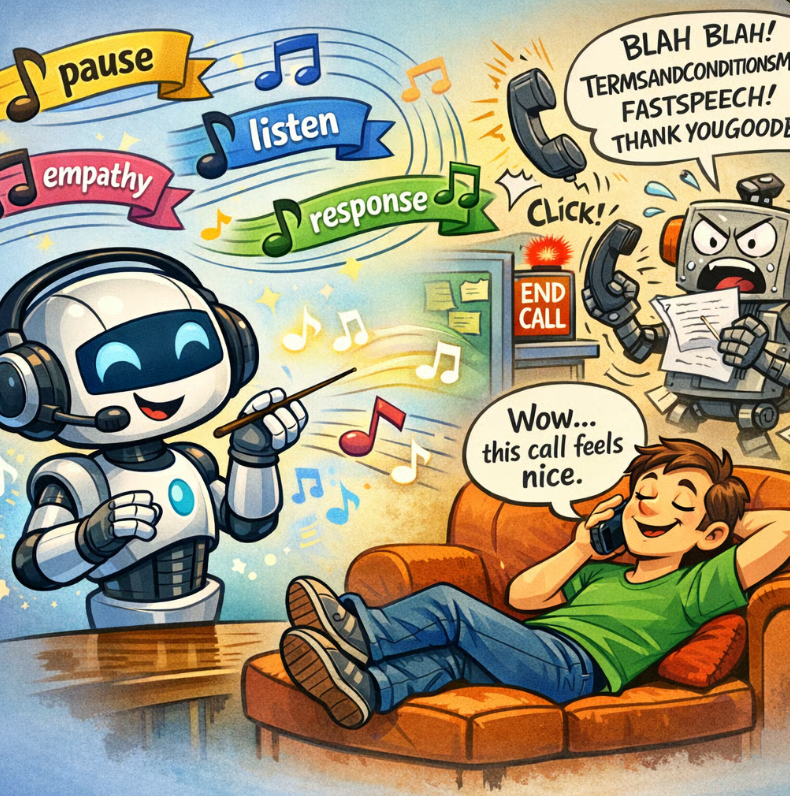
Why modern AI phone agents don’t just answer — they listen, respond, and flow the way humans do — but without fatigue, hesitation, or awkward pauses.
You’ve probably been on a call like this:
The person on the other end responds too fast, like a script on replay.
Or they speak too evenly, like a metronome that never breathes.
Or they pause too long, leaving you wondering if the other side even cares.
This is the fear most people have about automated voice systems:
That they’ll sound like an over-polished robot.
But today’s AI voice agents are nothing like the monotone bots of the past.
In fact, the reason they work — and work so well in sales and customer interactions — is because they control call pace without sounding robotic, and they do it by mimicking the unwritten laws of human conversation. And that’s not magic — it’s deliberate design.
Momentum Is the Invisible Engine of Conversation
Conversation isn’t just words coming out of mouths.
It’s rhythm.
It’s timing.
It’s pacing.
When a human speaks, their pace fluctuates — faster when confident, slower when thoughtful, softer when reflective, firmer when decisive. Those subtle changes tell the listener:
“I’m with you.”
“I’m thinking.”
“I’m responding to you.”
And that’s exactly what separates a real conversation from a machine read-aloud.
But how do AI voice agents do this without sounding mechanical?
3 Big Secrets behind Natural-Feeling AI Voice Conversations
1. They Match Your Pace — Not Replace It
Modern AI voice systems don’t talk at a fixed rhythm like old-school IVRs. Instead, they listen first — picking up on the cadence of the person on the other end — and then adapt. That means:
- Shorter sentences when the customer is decisive
- Slight pauses when the customer hesitates
- Richer phrasing when the topic deserves depth
By aligning with the speaker’s rhythm, AI feels fluid, not robotic.
2. They Use Empathy Cues (Not Just Scripted Lines)
A big reason traditional bots feel cold is because they skip the emotional glue in conversation. Humans don’t only talk — they soothe, validate, acknowledge and signal attention with small phrases like:
“I hear you.”
“That makes sense.”
“Let me think about that…”
Today’s AI voice agents sprinkle these cues naturally — not because they’re trying to “manipulate” emotion, but because they understand that pace without empathy feels like listening to a lecture, not a dialogue.
3. Smart Turn-Taking — No Interruptions, No Awkward Silences
Great conversation is like tennis: each speaker exchanges ideas in rhythm, without stepping on each other’s words. Advanced voice AI agents track pauses, pick up on intent, and only respond once the person has finished their thought.
That means no awkward bot interruptions, and no cold blank moments where silence feels Painful instead, the exchange flows naturally.
Why This Matters for Sales Conversations
Every sales leader knows this moment:
A prospect seems interested… then suddenly pauses… and the call just dies.
Not because the product is bad —
but because the conversation lost momentum.
In traditional call setups, this happens because:
- The rep interrupts too soon
- The rep talks over silence
- The rep rushes to “fill the gap”
- Or the rep doesn’t give the buyer space to think
But when AI voice agents control the pacing — listening before replying, adapting tempo, and responding with emotional cues — momentum stays alive.
Prospects feel heard.
Trust builds.
Responses become richer.
And that’s why AI voice isn’t just faster or cheaper — it’s more conversational.
SalioAI: Conversation at Human Tempo — Without Robot Vibes
This is where SalioAI redefines what sales calls can be.
SalioAI’s voice agents don’t just answer calls — they engage in meaningful dialogue:
✔ They respond instantly without sounding rushed or artificial.
✔ They adapt pacing to each customer’s tone and tempo.
✔ They use empathetic language, not robotic scripts.
✔ They handle objections naturally, not line by line.
✔ They book meetings, follow up, and convert — all without awkward rhythms.
The magic isn’t just that it sounds natural — it’s that it feels natural.
Prospects don’t hang up thinking “that was a bot.”
They leave the call feeling like they talked to someone who understood them.
The Science of Conversational Flow
In human psychology, the brain tracks patterns — not just words.
It notices changes in tone, shifts in pace, emotional rhythm, and timing of pauses.
A voice agent that ignores these cues?
That sounds stiff. Robotic. Predictable.
But a system that mirrors human pacing?
That signals:
- Attention
- Comprehension
- Respect
- Presence
These are the ingredients of trust — and trust is the currency of sales conversations.
When Machines Outperform Humans at Rhythm
This might sound paradoxical — but here’s the reality:
Humans are impressive communicators — but only when they’re not multitasking.
Voice AI agents, on the other hand:
- don’t get distracted
- don’t lose track mid-sentence
- don’t rush to the next task
- don’t interrupt because of impatience
They dedicate full attention to the conversational flow — every call, every time, without variance.
This creates a consistent rhythm — something even the best human reps struggle to maintain across dozens of follow-ups.
The Bigger Truth
Conversation isn’t just content — it’s context, timing, and rhythm.
And controlling the pace of a call — without sounding robotic — is not an accident.
It’s intentional design.
AI voice agents succeed where old bots failed because they understand the psychological choreography of human dialogue:
Listen.
Feel.
Respond.
Adapt.
Not monotone.
Not mechanical.
But alive in tempo.
That’s why prospects don’t just stay on the line longer with AI —
they talk more deeply, make decisions faster, and convert more often.
And when those conversations happen at scale, reliably and naturally? That’s when revenue doesn’t just happen —
it flows.
