

Support Quality Degrades Invisibly
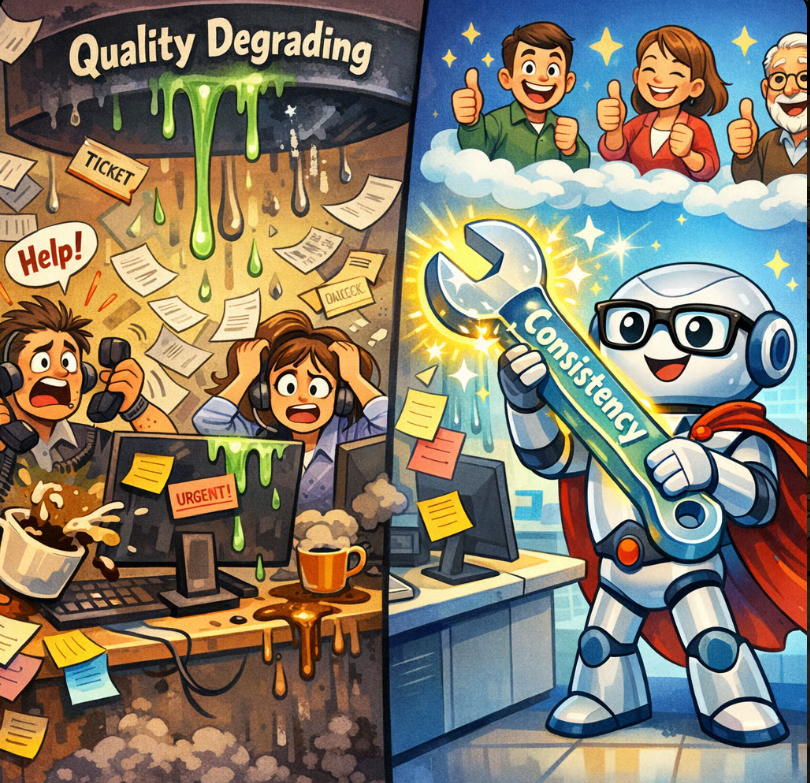
Why customer support can quietly become mediocre — without anyone noticing — and how the right systems prevent the slow leak of quality that costs customers, trust, and revenue.
Support quality doesn’t usually collapse dramatically.
There’s no dramatic crash.
No red “ERROR” flashing on the dashboard.
No sirens blaring in the control room.
Instead, it slips, like water leaking from a hidden pipe:
Small drop.
Small drip.
One unnoticed moment after another.
And suddenly — weeks later — customers are frustrated, churn rates tick up, satisfaction scores slide, and no one can quite put a finger on when it went wrong.
This is the invisible decay of support quality.
Why Support Quality Fails Without Anyone Noticing
Most leaders judge support quality by obvious metrics:
- Average handling time
- First call resolution
- CSAT scores
- Ticket volumes
But these numbers only tell part of the story.
A support organization can meet targets…
and still feel off to customers.
Here’s why:
When questions are routine, support seems great.
When issues are simple, replies feel snappy.
When calls are few, agents are attentive.
But as volume grows, complexity increases, and human attention fragments, something subtle happens:
➡️ responses become slower
➡️ knowledge gaps widen
➡️ empathy weakens
➡️ answers feel scripted
➡️ customers repeat themselves
None of these show up as “failures” in the metrics — but they erode quality in plain sight.
In fact, research shows that self‑service alone resolves only a tiny fraction of issues fully — barely 14% in one survey — meaning most customers switch to assisted channels seeking real help.
This means support is doing a lot of work, but much of it may be invisible to dashboards — and costly to customer loyalty.
The Subtle Signals Customers Feel First
Customers don’t think in numbers.
They think in experience.
And support quality isn’t judged by how fast you answer —
it’s judged by how well you resolve the problem.
Consider these invisible but powerful signals:
✨ repeating your information multiple times
✨ being transferred between agents
✨ receiving inconsistent answers
✨ longer pauses before responses
✨ lack of personalized context
None of these show up on basic dashboards —
but customers feel them immediately.
And once that feeling sets in?
Trust drains.
Engagement slides.
Retention declines.
This slow erosion doesn’t trigger alarms — but it chips away at revenue.
Where Humans Struggle Most
Human support teams are remarkable — empathetic, creative, intuitive.
But they also have limits:
📌 fatigue weakens attention
📌 knowledge gaps occur across shifts
📌 turnover fragments expertise
📌 time pressure accelerates errors
📌 inconsistent memory hampers continuity
Even with the best training, humans vary in performance across calls, time zones, and emotional conditions. This variation doesn’t show up in big numbers — but customers feel it, moment after moment.
And as support complexity rises — with more products, more channels, more questions — human inconsistency gets magnified across interactions.
Support quality doesn’t suddenly break.
It slowly leaks out — like light through a screen door.
Invisible Degradation Is More Costly Than You Think
When quality decays quietly, the consequences are subtle but profound:
📉 customer satisfaction weakens
📉 repeat contacts increase
📉 first‑call resolution drops
📉 brand trust erodes
📉 long‑term loyalty declines
None of these tend to explode overnight — but collectively, they compound into measurable business impact.
Most organizations insist they care about quality — but the truth is:
They focus on volume, speed, metrics
not sustained experiential quality.
And that’s where the invisible decay lives.
AI Voice Systems Preserve Quality by Design
This is why the shift toward voice AI — especially advanced systems like SalioAI — is transformative.
Unlike purely human support teams, AI voice systems don’t suffer from:
✔ fatigue
✔ attention lapses
✔ mood swings
✔ knowledge degradation over shifts
✔ drift in response quality
AI consistently applies the same logic, access to knowledge, and contextual awareness every time, 24/7.
Because quality isn’t something that happens by accident — it’s something that must be designed, calibrated, and preserved.
AI makes that possible.
How SalioAI Maintains Invisible Quality
SalioAI isn’t a replacement for people — it’s a quality shield for your support experience.
Here’s how it helps stop the slow leak of support quality:
✨ Consistency Every Time
AI delivers the same accurate, on‑brand response every time — eliminating human variation.
✨ Deep Context Awareness
No more scratching for details — SalioAI remembers conversation history and customer context across interactions.
✨ Instant Responsiveness
Customers never wait for an available agent — AI handles peak volumes without decline.
✨ Standardized Accuracy
Getting the right answer isn’t luck — it’s built into the system.
✨ Smooth Escalation When Needed
AI intelligently hands off complex issues to humans — preserving both efficiency and quality.
With SalioAI, there’s no invisible slip in experience as workload increases or hours pass — quality stays intact.
The Gap between Promise and Reality
It’s easy to think support quality only matters when something breaks badly.
But the reality is more subtle:
Support quality matters even when nothing obvious goes wrong.
Because customers judge your brand by how consistent every experience feels.
If one interaction feels competent, and the next feels uncertain, the whole experience feels unreliable.
Quality degradation doesn’t always scream — sometimes it sighs.
And customers hear that sigh.
The New Standard: Quality You Can Trust — Always
In an era where customers expect near‑immediate and accurate support from every channel:
🚀 speed is necessary but not sufficient
🚀 empathy is desired but not guaranteed
🚀 resolution is expected but not assured
What truly sets leading brands apart is support quality that never drifts, no matter how many interactions, how complex the channel, or how heavy the load.
That’s what SalioAI delivers.
Because when your support quality degrades invisibly — your revenue does too. And in a world where customer expectations rise every day, invisible decline is the most dangerous kind.
