

Human Errors Compound Faster Than System Errors
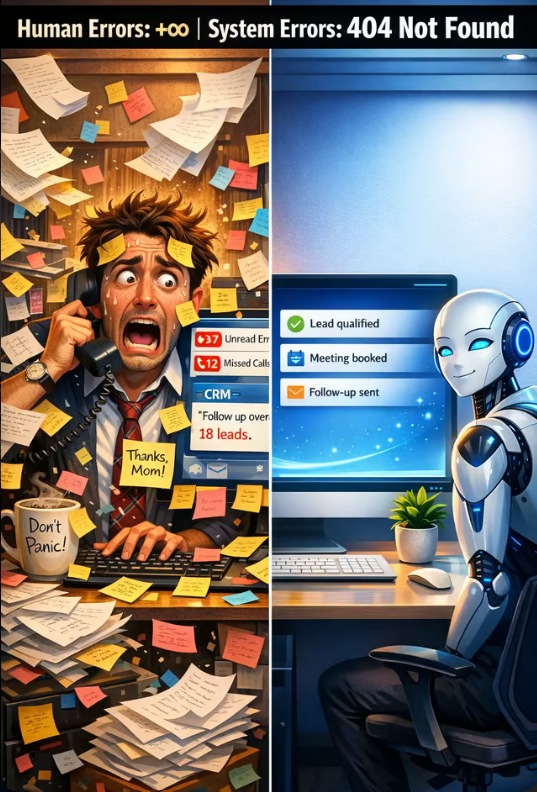
We like to blame systems.
“The CRM failed.”
“The automation broke.”
“The software had a bug.”
But if we’re honest, most revenue loss doesn’t come from system errors.
It comes from human inconsistency.
And human inconsistency compounds quietly.
The Dangerous Myth of “Human Touch”
For years, businesses have defended manual processes under one noble banner:
“We believe in the human touch.”
And yes — human connection matters.
But human dependency?
That’s something else.
Because humans:
- Forget to follow up.
- Misinterpret messages.
- Delay responses.
- Miss context.
- Make emotional decisions.
- Get tired.
Individually, these seem small.
Collectively, they compound.
And compounding errors are expensive.
The Compounding Effect Nobody Calculates
Let’s break this down practically.
A sales rep forgets to follow up with 3 leads this week.
Next week, 5 more slip through.
A support agent misreads a client’s urgency.
A delayed reply costs momentum.
A misunderstood question creates friction.
Each error feels minor.
But over 12 months?
- Hundreds of missed conversations
- Dozens of lost deals
- Countless damaged impressions
Human errors don’t explode.
They accumulate.
And accumulation kills growth quietly.
System Errors Are Loud. Human Errors Are Silent.
When a system fails, everyone notices.
Dashboards light up.
Alerts go off.
Teams jump in.
But when a human forgets to reply?
There’s no alarm.
When a prospect loses interest due to delay?
No notification.
When context is misunderstood?
No system log.
The opportunity just disappears.
And nobody tracks what never converted.
In the Attention Economy, Delay Is Death
Modern buyers move fast.
They compare instantly.
They decide quickly.
They expect clarity immediately.
If your team responds in:
- 5 hours instead of 5 minutes
- 1 day instead of instantly
You don’t just lose speed.
You lose psychological advantage.
Momentum is fragile.
And human inconsistency breaks momentum more often than technology ever does.
The Real Reset in Business
The next evolution in business isn’t about replacing humans.
It’s about removing compounding human friction.
High-growth companies are shifting from:
Human-dependent systems
to
Human-led, system-powered infrastructure.
Because systems:
- Don’t forget
- Don’t delay
- Don’t misinterpret tone
- Don’t get overwhelmed
They execute consistently.
And consistency compounds positively.
Where Sales Suffers the Most
Sales is the most sensitive to compounding human errors.
One delayed response.
One unclear explanation.
One forgotten follow-up.
That’s all it takes.
The buyer doesn’t wait.
They move.
And once momentum is gone, it rarely returns.
This is exactly why forward-thinking businesses are building intelligent layers that reduce dependency on human timing.
This is where SalioAI becomes more than a tool.
It becomes a safeguard.
SalioAI: Reducing Revenue Leakage
SalioAI doesn’t replace your team.
It protects your pipeline from human inconsistency.
It ensures:
- Every inquiry is answered instantly.
- Every question is understood in context.
- Every lead is qualified systematically.
- Every opportunity is captured — 24/7.
While your team sleeps, it listens.
While humans get overwhelmed, it executes.
While inboxes pile up, it responds.
That’s not automation.
That’s stability.
The Compound Advantage of Intelligent Systems
Imagine the opposite scenario.
Instead of compounding errors, you compound:
- Immediate responses
- Consistent clarity
- Structured qualification
- Seamless follow-ups
Over 12 months, that doesn’t just improve conversion.
It reshapes growth.
Because compounding consistency builds trust.
And trust builds predictable revenue.
The Strategic Question
Are you building a business dependent on perfect human execution?
Or are you building a business reinforced by intelligent systems?
Humans should lead strategy, empathy, creativity.
But revenue-critical moments?
They require precision.
And precision cannot rely on memory, mood, or manual effort.
The Companies That Will Win
The next decade will reward:
- Businesses that reduce friction.
- Businesses that eliminate silent revenue leaks.
- Businesses that design systems around reliability.
Human errors compound quietly.
System consistency compounds powerfully.
The difference between the two is not technology.
It’s foresight.
And companies implementing intelligent infrastructure like SalioAI are not just automating conversations.
They’re eliminating the invisible losses that slow growth.
Human errors compound faster than system errors.
The question is: Are you letting inconsistency dictate your revenue — or are you engineering stability into your business?
