

The Problem with Human‑Dependent Sales Teams
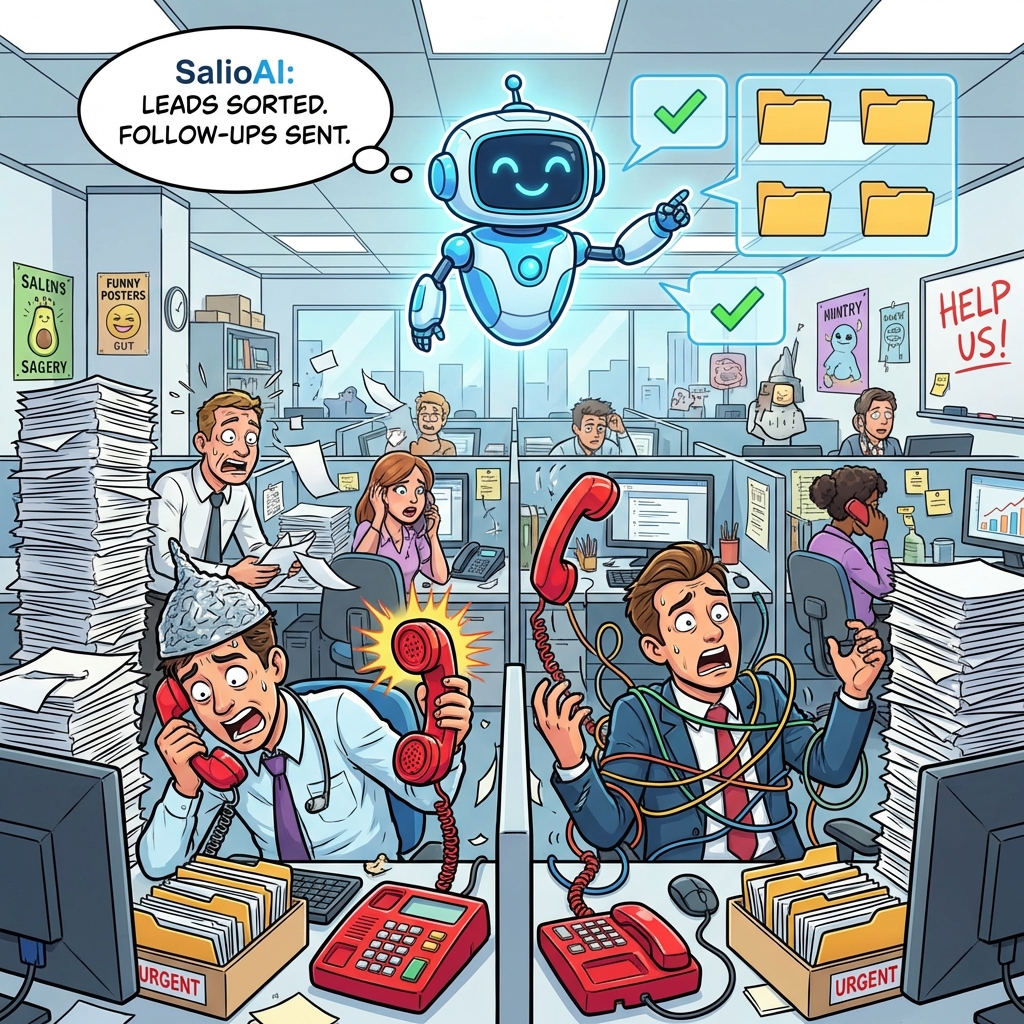
For decades, sales has been treated like a human sport.
If you want more revenue, hire more sellers.
If you want better outreach, train your people harder.
If you want more conversations, put someone on the phone.
If you want more follow‑ups, give it to a rep with stamina.
But something strange is happening.
That old playbook still shows activity—but it no longer reliably produces results.
Companies are busier than ever, yet pipeline stagnates.
Leads come in, but follow‑ups get drowned in noise.
Sales teams are overloaded, yet conversions lag.
CRM dashboards show motion, but revenue flat lines.
Somewhere in the midst of all that effort, sales stops scaling.
And no one wants to say the obvious truth:
Relying on humans alone to run your sales engine is becoming a fundamental growth bottleneck.
Not because people are useless.
Not because humans aren’t skilled.
But because the modern buying cycle, the pace of business, and the expectations of buyers have outgrown the traditional model of human‑dependent sales.
The Human Limitation Everyone Ignores
It starts out innocently:
One salesperson handles outreach manually.
They build relationships.
They chase follow‑ups.
They track responses.
They juggle opportunities in their head and in spreadsheets.
At first it works — because there aren’t many leads, and the team can manage manually.
But as a business grows, three harsh realities emerge:
1. Humans have limited capacity
your best rep can’t have thousands of meaningful engagements every month. They simply can’t. Their time is finite.
2. Humans get overwhelmed by repetitive work
Prospecting, manual follow‑ups, sorting lead lists — these tasks are essential, but they are also exhausting and distracting. No human thrives on repetition at scale.
3. Humans make inconsistent decisions under load
two reps with the same script will produce different results — not because they lack skill, but because emotion, timing, energy, and context always vary.
In other words: human‑dependent teams are inconsistent by design.
And inconsistency kills predictable growth.
Activity vs Results: The Invisible Disconnect
Look at most sales teams today.
They are incredibly busy.
Slack channels buzzing.
CRM notifications piling up.
Outreach tools humming.
Reports showing activity everywhere.
Yet pipeline movement feels slow.
Forecasts feel guess.
Momentum feels conditional.
Why?
Because activity ≠ results.
Activity looks like:
• 1000 emails sent
• 300 calls made
• 150 LinkedIn messages
• 400 CRM updates logged
Results look like:
• Timely replies
• qualified conversations
• booked meetings
• progressing opportunities
• revenue generated
Notice the difference?
Activity is output.
Results are outcome.
Human‑dependent teams often excel at output.
They are busy, visible, and hardworking.
But they do not always generate outcomes at scale — because outcomes depend on consistency, timing, prioritization, and follow‑through in a way that humans cannot sustain alone.
The Hidden Cost of Manual Sales Work
It isn’t just about slow follow‑ups or overwhelmed reps.
The real cost is far deeper:
• Reps spending hours sorting leads instead of selling
• Opportunities cooling because follow‑up was late
• Miscommunication between teams because no system ties conversations together
• Data scattered across tools and inboxes
• High‑value conversations dropped because someone got busy
This is the paradox:
You can have a larger team and still lose deals because your processes are still manual.
You can increase headcount and decrease visibility.
You can spend more money and get less momentum.
That’s the real danger of human‑dependent sales teams — they are dependent rather than durable.
The Scale Problem Humans Can’t Solve Alone
Growth means scale.
But scale magnifies every weakness.
A manual process that works for 10 leads per week will fail at 100 or 1000 leads per week.
It collapses under its own volume because:
• Humans tire
• Dates get forgotten
• Follow‑ups slip
• Response times lag
• No one knows who should take next action
In short, without systemic support, human effort becomes chaotic at scale.
The result?
You get:
• Noisy pipelines
• unpredictable revenue
• uneven performance across the sales force
• burnout
• a false sense of “busyness” that isn’t translating into growth
If your pipeline feels like a pressure cooker with no release valve, this is why.
The Modern Buyer Has Higher Expectations
Here’s the uncomfortable fact:
Buyers today are faster, savvier, and less patient than ever before.
They expect:
• rapid responses
• relevant messaging
• clarity
• timely follow‑ups
• personalization without delay
• conversations that move forward — not stall
And when a company depends on humans alone to deliver all of that?
Responses vary.
Timing slips.
Engagement lags.
Momentum stalls.
Buyers walk away before someone even replies.
And no sales team — no matter how talented — can keep up when every minute counts and opportunity windows close within hours, not days.
This Is Not the End of Humans in Sales
Let’s be clear:
No one is arguing that humans don’t matter.
They matter deeply.
Humans are essential for:
• building trust
• handling complex negotiations
• delivering judgment
• reading emotional context
• making strategic decisions
But humans are not — and never will be — the best tool for repetitive, high‑volume, timing‑critical work that sits at the foundation of predictable sales pipelines.
That layer needs infrastructure.
It needs automation, consistency, prioritization, speed, and intelligence that humans simply cannot sustain on their own.
The Shift: From Human‑Dependence to Hybrid Systems
This is where the real revolution in sales is already happening.
The most effective teams are not trying to replace humans.
They are trying to amplify what humans do best and to automate the work humans are weak at.
They are building sales systems that look like this:
✔ automated lead qualification
✔ rapid first engagement
✔ schedule‑aware follow‑up sequences
✔ real‑time intent prioritization
✔ reduced manual workload
✔ consistent conversation flow
✔ teams focused on high‑impact work, not busywork
This is not hype.
This is how modern sales teams are already accelerating results while reducing churn, fatigue, and noise.
SalioAI: Where Human Talent Meets Scalable Conversation Infrastructure
If the core problem with human‑dependent sales teams is reliance on people to execute manual work, then the key to solving it — at scale — is to build systems that handle that work consistently and intelligently.
That is where SalioAI becomes more than just another software tool.
SalioAI helps companies:
🌟 automate repetitive outreach
🌟 prioritize the highest‑value leads
🌟 respond faster and more responsively
🌟 reduce human workload on grunt tasks
🌟 create consistent follow‑ups without slips
🌟 empower humans to focus on moments that truly require judgment
In other words:
Instead of asking “How many people do we need to hit our goals?”
SalioAI helps teams ask:
“How can we engage more prospects, more consistently, with fewer gaps, and without burning out our most valuable people?”
That is not selling automation for the sake of speed.
It is building conversation infrastructure — work that humans alone cannot do well at scale, but that dramatically magnifies human impact when it is systematized.
Why the Best Sales Teams Will Always Be Human + AI
In the future of growth:
• Machines handle consistency
• AI handles volume
• Humans handle judgment
• People close deals, build relationships, make decisions
The most successful companies will be those that do not cling to old models of manual effort.
They will be the ones that understand where humans add the most value — and where machines should carry the rest.
Human‑dependent sales teams are not obsolete.
But sales teams that rely entirely on humans for everything — especially repetitive operational work — are becoming dangerously slow, inefficient, and unpredictable.
Final Thought
Dependence on human effort alone was fine in an era of slower markets, fewer channels, delayed responses, and buyer patience.
But that era is gone.
Today, sales success depends on speed, structure, consistency, and context.
It depends on a system that can capture interest, engage intelligently, follow up relentlessly, and prioritize opportunity — all before a human could even open their inbox.
The companies that thrive will be those that embrace this new model:
A hybrid approach where technology handles what it does best, and humans focus on what they do best.
That is the future of predictable revenue. And SalioAI is one of the solutions helping companies make that shift with speed, intelligence, and impact — not chaos and guesswork.
