

Why Scaling Conversations Is Harder Than Scaling Products
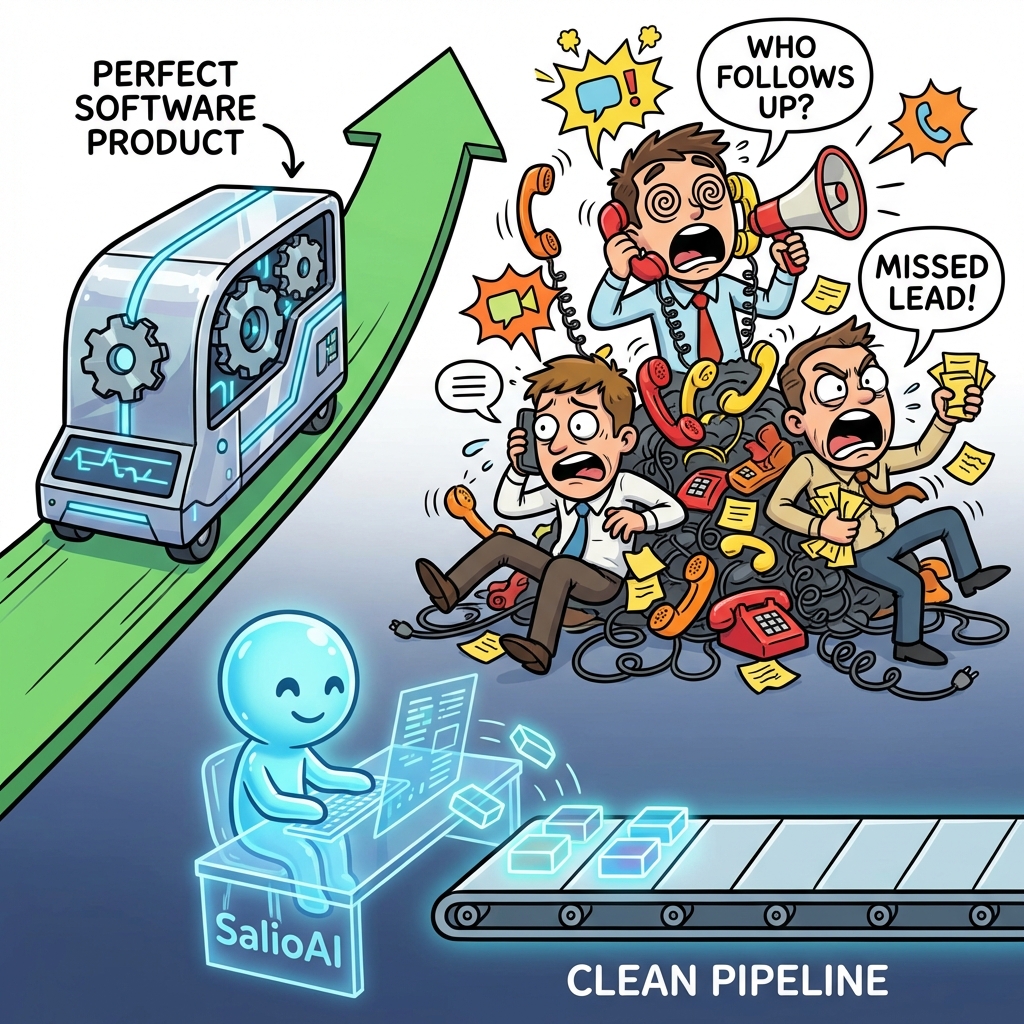
There’s a moment every growing company experiences.
Your product starts working.
Customers sign up.
Revenue increases.
Demand builds.
And suddenly, scaling feels… possible.
So you do what every smart company does:
You optimize the product.
You improve infrastructure.
You prepare for growth.
And the product scales beautifully.
More users? No problem.
More traffic? Handled.
More demand? Supported.
But then something unexpected happens.
The product scales.
The conversations don’t.
The Illusion: Products Scale Infinitely
Products are built to scale.
Software doesn’t get tired.
Servers don’t forget.
Systems don’t delay because they’re “busy.”
Once built, a product can serve:
10 users
1,000 users
100,000 users
Without fundamentally changing how it operates.
That’s the magic of product scalability.
It’s predictable.
It’s structured.
It’s repeatable.
The Reality: Conversations Don’t Scale Naturally
Now look at conversations.
Every new customer brings:
Questions
Doubts
Clarifications
Follow-ups
Objections
Timing expectations
And suddenly, growth looks different.
Because conversations are:
Unstructured
Emotional
Time-sensitive
Context-heavy
Unpredictable
And most importantly—
they depend on humans.
The Hidden Bottleneck No One Plans For
At low volume, conversations feel manageable.
A few calls.
Some emails.
Occasional follow-ups.
Your team handles it.
But as volume increases, something subtle begins to break.
Not loudly.
Quietly.
• Responses take longer
• Follow-ups become inconsistent
• Context gets lost
• Leads slip through gaps
• Conversations restart from zero
Nothing explodes.
But everything slows down.
The Scale vs Quality Trap
Here’s where it gets tricky.
When you try to scale conversations, you face a brutal trade-off:
Volume vs Quality
Research shows:
- Manual, high-quality outreach gets 30–40% response rates but very limited scale
- High-volume automation scales massively but drops response rates to 2–5%
So companies are forced into a bad choice:
Scale fast → lose quality
Maintain quality → limit growth
That’s the core problem.
Products don’t face this trade-off.
Conversations do.
Why Conversations Break Faster Than Products
Let’s get specific.
1. Conversations depend on timing
If you respond in seconds → you win
If you respond in hours → you lose
Data shows:
- Responding within 1 hour makes you 4x more likely to qualify a lead
- Leads contacted within 1 minute are 39x more likely to convert
Products don’t lose value with time.
Conversations do.
2. Conversations require consistency
At scale, consistency breaks first.
From real-world experience:
“Follow-ups slipped… context disappeared… performance degraded quietly.”
Not because strategy failed.
Because humans couldn’t execute perfectly—every time.
3. Conversations create exponential complexity
More leads don’t just mean more work.
They mean:
More decisions
More prioritization
More tracking
More coordination
At scale:
- 20 reps → 100–150 conversations daily
- 200 reps → 500–750 hours of conversation data per day
This isn’t just “more volume.”
It’s a complexity explosion.
4. Humans are the limiting factor
Humans are great at:
Trust
Empathy
Closing
But weak at:
Instant response
Perfect follow-up
High-volume consistency
And yet…
That’s exactly what scaling conversations demands.
The Dangerous Assumption: “We’ll Just Hire More”
This is where most companies go wrong.
They think:
More conversations → hire more people
But hiring doesn’t fix the system.
It amplifies the problem.
Because now you have:
More handoffs
more delays
More inconsistency
More communication gaps
And suddenly…
Scaling conversations becomes more chaotic, not more efficient.
Meanwhile, the Market Has Already Changed
Here’s what makes this dangerous.
The market is no longer operating at human speed.
Buyers expect:
Instant replies
Continuous engagement
No delays
No dropped conversations
In fact:
- 67% of buyers say fast response is critical in choosing a company
- 78% of buyers often go with the first responder
So now the challenge isn’t just handling conversations.
It’s handling them faster than everyone else.
The Shift: Conversations Need Systems, Not Just People
This is the realization top companies are quietly arriving at:
Conversations must be systemized—just like products.
That means:
Structured follow-ups
Instant response layers
automated prioritization
Consistent engagement flows
Real-time lead handling
Because without systems…
Conversations collapse under scale.
Where SalioAI Changes the Game
This is exactly where SalioAI becomes critical.
Because the problem isn’t “more conversations.”
It’s managing conversations without losing speed, quality, and consistency.
SalioAI helps businesses:
✔ Respond instantly to every lead
✔ Maintain follow-ups without gaps
✔ Prioritize high-intent conversations automatically
✔ Keep engagement alive 24/7
✔ Remove human dependency from repetitive tasks
So instead of:
Scaling people → to manage conversations
You:
Scale systems → to handle conversations intelligently
The New Model: Product Scales + Conversation System Scales
The companies that win going forward will not just scale their product.
They will scale their conversation layer.
Where:
Products deliver value
Systems manage interaction
Humans close deals
This creates something powerful:
Unlimited interaction capacity
Consistent experience
Faster response times
Higher conversion rates
Final Thought
Scaling a product is a technical problem.
Scaling conversations is a human + system problem.
That’s why one feels easy…
…and the other quietly breaks your growth.
Most companies will continue trying to scale conversations with:
More hiring
More effort
More pressure
And they will hit the same wall.
But the companies that see this early will ask a different question:
“How do we build a system where conversations scale without breaking?”
That’s where the real advantage is.
And increasingly, that advantage is being built with tools like SalioAI—not to replace humans… …but to make sure growth doesn’t depend on human limits
