

How Founders Build Predictable Customer Interaction Systems
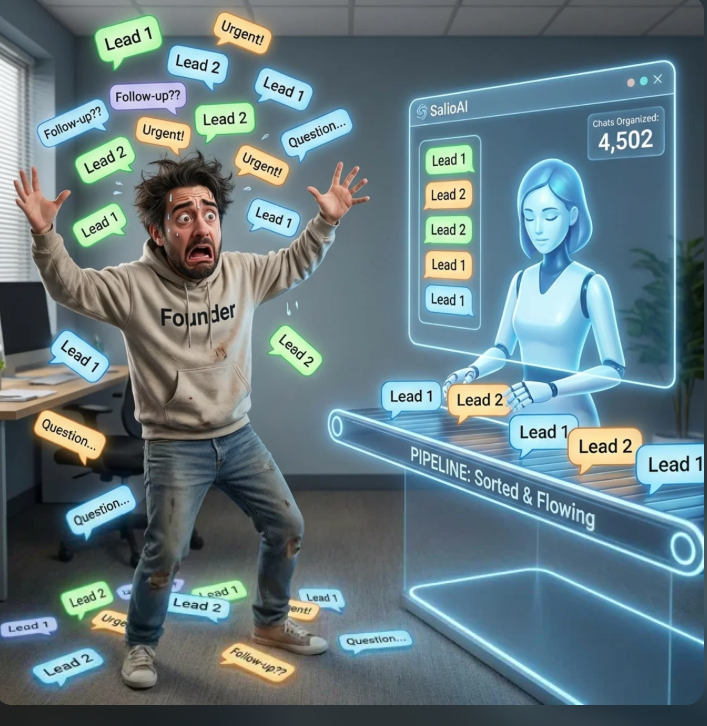
Something feels unpredictable… even when everything is working
Leads are coming in.
Teams are active.
Conversations are happening.
But revenue?
It doesn’t feel stable.
One week:
- Great conversions
- Strong pipeline
- Momentum
Next week:
- Silence
- Drop-offs
- Confusion
And founders start asking:
“Why is growth so inconsistent… when everything looks fine?”
The hidden truth: your conversations are random
Most founders don’t see this at first.
Because activity looks like progress.
- Messages are being sent
- Calls are being made
- Follow-ups are happening (sometimes)
But if you zoom in…
Every lead is getting a different experience.
- Different response time
- Different tone
- Different follow-up
- Different outcome
That’s not a system.
That’s uncontrolled variability.
And variability kills predictability
Here’s what the data shows:
- 78% of customers buy from the first responder
- Responding within 5 minutes makes you 21x more likely to qualify a lead
- But most businesses still respond in hours — even 40+ hours
So what’s really happening?
Your revenue depends on timing…
but your timing depends on humans.
And humans are inconsistent.
The moment that decides everything
When a lead comes in…
There is a short window where:
- Attention is high
- Intent is real
- Decisions are forming
This is the peak interaction moment.
But it fades fast:
- After 5 minutes → qualification odds drop sharply
- After 30 minutes → you’re already losing
- After 1 hour → you’re chasing, not converting
And most businesses?
They don’t even show up in time.
This is why growth feels unpredictable
Because your system isn’t designed for:
- Speed
- Consistency
- Continuity
Instead, it depends on:
- Who saw the lead
- Who replied
- Who followed up
So outcomes vary.
Not because demand changes…
But because execution changes.
What smart founders are starting to do differently?
They stop asking:
“How do we get more leads?”
And start asking:
“Why do our interactions feel random?”
Because once you see it clearly…
Customer interaction is not a task.
It’s a system.
The shift: from conversations → interaction systems
Old model:
- Lead comes in → team reacts
- Questions are asked → based on person
- Follow-ups happen → if remembered
New model:
- Lead enters → system responds
- Conversation flows → based on logic
- Follow-ups happen → automatically
This is the difference between:
Managing conversations
vs
engineering interactions
What predictable interaction systems actually look like
Let’s break it down simply.
1. Instant engagement (every time)
No delay.
No “we’ll get back to you.”
Because:
Speed is no longer an advantage
It’s the minimum requirement
2. Defined conversation entry points
Every lead doesn’t start randomly.
- Ad lead → one path
- Organic lead → another
- Returning lead → different flow
Now conversations start with context.
3. Structured qualification (not guessing)
Instead of:
- “Tell me your requirements”
You guide:
- Problem → intent → urgency
This filters and moves forward at the same time.
4. Built-in follow-up logic
This is where most businesses lose money.
Without a system:
- Follow-up = optional
With a system:
- Follow-up = guaranteed
And that alone changes conversion rates.
5. Continuous interaction (no dead ends)
Most conversations die silently.
A system ensures:
- No reply → re-engage
- Delay → nudge
- Interest → accelerate
No lead just disappears.
Why this is becoming critical in 2026
Because expectations have changed.
- 82% of customers expect an immediate response
- 71% will leave if response is slow
And here’s the real shift:
Customers don’t compare products first
they compare experiences first
Where most founders get stuck
They try to fix this by:
- Hiring more salespeople
- Training teams
- Writing better scripts
But none of that fixes:
- Timing
- Consistency
- Scale
Because the problem isn’t effort.
It’s architecture.
Where SalioAI fits (this is the system layer)
This is exactly where SalioAI comes in.
Not as a chat bot.
But as your customer interaction system.
What changes when you implement it
1. Every lead gets instant engagement
No delays. No missed opportunities.
2. Conversations follow a defined structure
No randomness. No guesswork.
3. Qualification happens automatically
Sales only talks to serious prospects.
4. Follow-ups are built-in
No lead disappears silently.
5. Experience becomes consistent
Every interaction feels the same — at scale.
What founders start noticing?
Not immediately.
But over time:
- Fewer leads drop off
- Conversations feel smoother
- Sales become predictable
And then the realization hits:
“It was never about more leads…
it was about better interactions.”
The deeper shift (this is the real story)
This isn’t about sales.
It’s about how businesses operate.
We’re moving from:
- Activity-driven growth
→ to - System-driven growth
From:
- Human-dependent execution
→ to - Designed interaction systems
Final thought
If 100 leads come into your business today…
Will they all experience:
- The same speed?
- The same quality?
- The same journey?
Or will it depend on:
- Who’s available
- Who’s paying attention
- Who remembers
Because that answer defines whether you have:
A funnel
or
a system
One question to take with you
Right now:
Are your customer interactions predictable…
or are they just happening?
Because the founders who win in this new era…
Don’t just manage conversations.
They design systems that never break.
🚀 If you want to build that system
Don’t start with more leads.
Don’t start with more hires.
Start with:
Fixing what happens after the lead comes in. That’s exactly what SalioAI is built for
