

The Talent Pipeline on Autopilot: How AI Voice Automation is Reshaping the Recruitment and Staffing Industry
Introduction: The High-Stakes Hunt for Talent
In the recruitment and staffing industry, speed is the currency of success. The race to find, engage, and place the best candidates is a relentless, around-the-clock endeavor. In a talent-driven market, the firm that can connect with qualified candidates first often wins the placement. However, the traditional recruitment process is laden with administrative bottlenecks, from manual candidate screening to the logistical nightmare of interview scheduling. This chapter explores how AI voice automation is emerging as a transformative force in the recruitment and staffing industry, enabling firms to build a more efficient talent pipeline, enhance the candidate experience, and ultimately, make more placements.
Section 1: The State of the Recruitment and Staffing Industry: A War for Talent
The recruitment and staffing industry is at the epicenter of the global war for talent. As companies across all sectors compete for a limited pool of skilled professionals, the role of the recruiter has become more critical and more challenging than ever before.
The Recruitment Lifecycle: A Complex and Time-Sensitive Process
The recruitment lifecycle is a multi-stage process that requires a delicate balance of speed, precision, and human touch. The key stages and their associated challenges include:
- Sourcing and Candidate Identification: Recruiters source candidates from a variety of channels, including job boards, LinkedIn, and their own internal databases. The challenge is to identify qualified candidates who are open to new opportunities.
- Candidate Screening and Qualification: Once a potential candidate has been identified, a recruiter must screen them to determine if they are a good fit for the role. This is often a time-consuming and repetitive process.
- Interview Scheduling: Coordinating the schedules of the candidate, the hiring manager, and the recruiter can be a major logistical challenge. The back-and-forth of scheduling can lead to delays and a poor candidate experience.
- Offer and Placement: If the candidate is successful, the recruiter will extend an offer and guide them through the placement process. This can involve salary negotiations, background checks, and onboarding.
The Pain Points of the Modern Recruiter
- The Black Hole of Resumes: Recruiters are often inundated with a high volume of resumes, many of which are not a good fit for the roles they are trying to fill. Sifting through this mountain of data can be a major time sink.
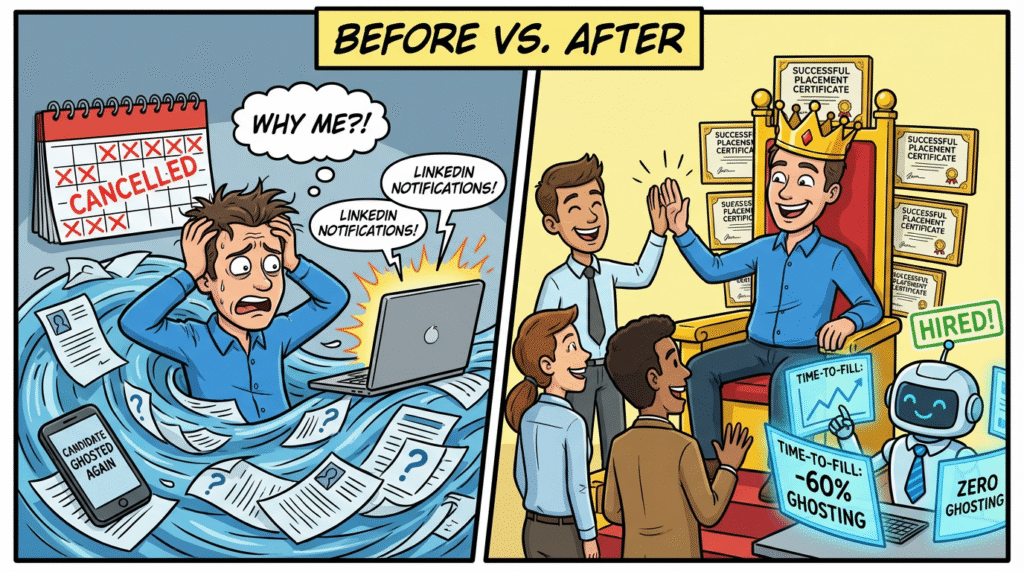
- The Candidate Ghosting Phenomenon: In a competitive talent market, it is not uncommon for candidates to “ghost” recruiters, failing to show up for interviews or to respond to messages. This can be a major source of frustration and wasted time.
- The Administrative Burden: A significant amount of a recruiter’s day is spent on administrative tasks, such as scheduling interviews, sending follow-up emails, and updating the applicant tracking system (ATS).
- The Need for a Personalized Candidate Experience: Today’s candidates expect a personalized and engaging experience. A generic, one-size-fits-all approach to recruitment is no longer effective.
Section 2: The Transformative Power of AI Voice Automation in Recruitment and Staffing
AI voice automation is providing a powerful solution to the challenges that have long plagued the recruitment and staffing industry. By automating many of the administrative and repetitive tasks that are currently handled by human recruiters, AI can help them to be more efficient, more effective, and more strategic.
How AI Voice Automation Works in a Recruitment Setting
AI voice automation platforms can be integrated with a firm’s existing applicant tracking system (ATS) and CRM. The AI agents can be programmed to:
- Screen Candidates 24/7: The AI agent can call a new applicant within seconds of them applying for a job. It can ask a series of screening questions to determine if they meet the basic qualifications for the role.
- Schedule Interviews: The AI agent can access the calendars of the recruiters and hiring managers and schedule phone screens and in-person interviews in real-time.
- Send Reminders: The AI agent can send automated reminders to candidates before an interview to reduce the likelihood of a no-show.
- Answer Frequently Asked Questions: The AI agent can be trained to answer common questions about a role, such as the salary range, the benefits, and the location.
The ROI of AI Voice Automation in Recruitment and Staffing
The ROI of AI voice automation in the recruitment and staffing industry can be measured in terms of both time and placements. By automating the top of the recruitment funnel, firms can:
- Reduce Time-to-Fill: By screening candidates and scheduling interviews more efficiently, AI can help to reduce the time it takes to fill a role.
- Increase Recruiter Productivity: By freeing up recruiters from administrative tasks, they can focus on what they do best: building relationships with candidates and clients.
- Improve the Candidate Experience: A seamless and professional communication process can create a positive impression and enhance the firm’s brand.
- Build a More Robust Talent Pipeline: By engaging with every applicant, the AI agent can help to build a more robust and diverse talent pipeline for future roles.
Section 3: The Competitive Landscape: How Recruitment Innovators are Embracing AI
The recruitment and staffing industry is being transformed by a new wave of technology-driven companies that are embracing AI to gain a competitive edge.
- HireVue: The video interviewing platform uses AI to analyze a candidate’s facial expressions, tone of voice, and word choice to assess their skills and personality.
- Textio: The augmented writing platform uses AI to help companies write more effective and inclusive job descriptions.
- Ideal: The AI-powered talent screening and matching platform helps recruiters to identify the best candidates from a large pool of applicants.
Section 4: Your Implementation Roadmap: A Blueprint for Building an AI-Powered Recruitment Engine
For recruitment and staffing firms, the implementation of AI voice automation can be a straightforward and cost-effective process. Here is a four-step roadmap to guide you:
- Integrate with Your ATS: The first step is to choose an AI voice automation platform that can be seamlessly integrated with your existing applicant tracking system. This will ensure a smooth workflow and provide the AI agent with the information it needs to be effective.
- Start with a High-Volume Role: It is often best to start with a high-volume role, such as a customer service representative or a sales development representative. This will allow you to test the platform and demonstrate its value before rolling it out to your entire firm.
- Create a Candidate-Centric Script: The AI agent should be designed to provide a positive and engaging experience for the candidate. Work with the platform provider to create a script that is friendly, professional, and informative.
- Train Your Recruiters to be AI-Powered: The AI agent is not a replacement for your recruiters; it is a tool to help them be more effective. It is important to train your recruiters on how to work with the AI agent and how to leverage the information it provides.
Section 5: The Future of Recruitment and Staffing: The Augmented Recruiter
The future of recruitment is not about replacing human recruiters with robots. It is about creating the “augmented recruiter”—a human recruiter who is empowered by the power of AI. In this future, AI will handle the administrative and repetitive tasks, freeing up the recruiter to focus on the human aspects of the business: building relationships, providing career advice, and acting as a trusted partner to both candidates and clients.
Conclusion: The Ultimate Sourcing Strategy
In the war for talent, the firms that can most effectively leverage technology to build a more efficient and effective recruitment engine will be the ones that succeed in the years to come. AI voice automation is a powerful tool that can help you to do just that. By embracing this technology, you can build a more profitable, more efficient, and more candidate-centric firm, and gain the ultimate sourcing advantage in the hunt for top talent.
