

Open Models vs Proprietary Engines: Which Makes the Best Sales Voice Agent?
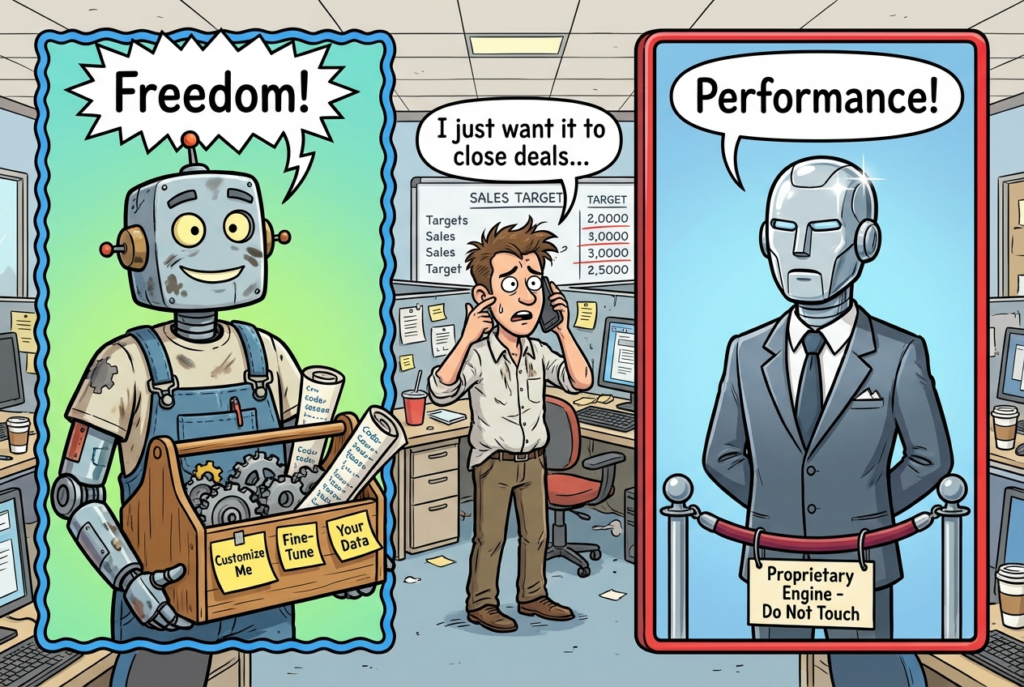
Imagine walking into a bustling marketplace. On one side, there’s a crowd of open artisans — each offering tools you can tweak, reshape, and customize to match exactly what you want. On the other side, there’s a sleek boutique where every product is polished, optimized, and ready to use, but locked behind glass. Both camps promise greatness. Both have fervent supporters. But when it comes to sales voice agents — the systems that listen, interpret, and respond in real time — the choice between open models and proprietary engines isn’t just technical. It’s philosophical, strategic, and deeply connected to how you want your business to relate to customers.
Let’s unravel this story with color, clarity, and curiosity — because picking the right voice agent isn’t just a technology decision. It’s a choice about how you show up with every customer interaction.
🎤 What Do We Mean by “Open” vs “Proprietary”?
Before we go further, let’s set the stage:
📦 Open Models
These are systems built on technologies that are accessible, transparent, and customizable. Developers can see “under the hood,” adapt the logic, retrain or refine parts of it, and tailor it to specific needs.
Think of open models as blank canvases — you bring the ideas, the culture, the nuance. The paint is there; you decide the picture.
🔐 Proprietary Engines
These are black-boxed, fully managed, and tightly optimized systems owned by platforms with powerful infrastructure and specialized algorithms. You plug in your data, configure some settings, and the system runs.
This is pre-sculpted marble — exquisite craftsmanship, but with less freedom to reshape the form.
Both sides have strong cases. Let’s explore how they perform in the wild — especially when it comes to real human conversations in sales.
🤝 1. Customization: Tailored Voice vs Ready-Made Scripts
Sales conversations are messy.
Prospects:
- Shift tones mid-sentence
- Ask unexpected questions
- Reveal emotion before logic
- Jump between topics without warning
Open models triumph when you need deep customization. You can:
✔ Tailor responses to your brand voice
✔ Inject industry-specific terminology
✔ Adjust for regional dialects
✔ Embed product knowledge in conversational memory
This means the voice agent doesn’t just “respond” — it speaks like you. It carries nuance, personality, and identity.
Proprietary engines, by contrast, can feel elegant but generic. They excel at standard responses — quick, reliable, polished — but can stumble when the conversation steps outside the common path.
In short: Open models = your voice. Proprietary engines = their voice.
⚡ 2. Performance & Responsiveness: Speed vs Precision
In sales, every millisecond matters. A pause isn’t just technical lag — it’s a psychological break in connection.
Proprietary engines often win on performance out of the box:
- Optimized inference speed
- Scalable infrastructure
- Managed services that handle spikes with ease
This matters especially when you scale to thousands or millions of interactions.
Open models can get there too, but it requires intentional engineering — caching layers, efficient pipelines, intelligent fallbacks — which means investment in infrastructure.
Bottom line: If you want fast, reliable performance without building the plumbing yourself, proprietary engines get you there quickly. If you want bespoke intelligence at scale, open models can achieve parity — but you need expertise and effort.
🧠 3. Intelligence & Adaptability: Evolution vs Stability
One way to judge voice agents is not just by how they answer today — but how they grow tomorrow.
Open models are inherently adaptable. You can:
- Retrain with your own conversational data
- Build feedback loops that refine performance
- Inject context from CRM and business systems
- Evolve responses as your product and market shift
They become living systems that learn from you — not just from a static training set.
Proprietary engines bring refined algorithms and robust foundations. They’ve been trained on massive datasets and often have strong built-in capabilities for language understanding.
The tradeoff?
- Proprietary engines: stable intelligence, broad coverage
- Open models: intelligent systems that learn your business deeply
If your selling process evolves quickly (and it does), that ability to adapt isn’t a luxury — it’s a competitive edge.
🔒 4. Control & Trust: Who Owns the Conversation?
Sales voice agents don’t just handle data — they carry your relationship with the customer. That’s powerful.
Open models grant maximum control:
- You decide how data flows
- You determine storage and compliance
- You can audit and refine how decisions are made
- You reduce dependency on external black boxes
This is especially important if you work in regulated industries like finance, healthcare, or legal services.
Proprietary engines may handle compliance too, but they often do so on their terms. You trust them — but you don’t fully control them.
Control here isn’t just technical — it’s trust with your customers.
💰 5. Cost: Short-Term Ease vs Long-Term Value
Proprietary engines often feel cheaper up front. You don’t need a big team or architectural investment. You get immediate value.
Open models may require:
- Developers
- DevOps support
- Ongoing refinement
- Monitoring tools
But what many leaders overlook is that long-term value compounds with open models:
- Lower dependency costs
- Better insight into your own data
- More strategic adaptability
- Future-proofed AI systems
Sometimes saving money today costs you control tomorrow.
✨ 6. Which One Makes the Best Sales Voice Agent?
Here’s the heart of the matter:
Choose Open Models if:
⭐ You want deep customization
⭐ Your sales flow is unique or complex
⭐ You care about owning data and voice
⭐ You want AI that learns your business
⭐ You plan to scale with refinement over time
Choose Proprietary Engines if:
🔥 You want fast time to deploy
🔥 You need polished performance immediately
🔥 Your interactions are standard and predictable
🔥 You prefer managed infrastructure over DIY
🎤 The Real Answer Isn’t Binary
The best sales voice agent isn’t always purely open or purely proprietary. Many teams build hybrid architectures — using proprietary engines for baseline language understanding and open models for domain-specific fine-tuning.
Because in sales, as in life, nuance wins.
When the system feels human, speaks like your brand, and responds with intelligence and empathy, customers don’t just convert — they connect. And that’s the real north star.
📌 The Bottom Line
Voice AI isn’t a tool — it’s a voice.
And the question isn’t simply open vs proprietary. It’s:
➡ Which voice reflects your values?
➡ Which voice understands your customers best?
➡ Which voice grows with you — not just for you?
Open models offer freedom, adaptability, and deep ownership.
Proprietary engines offer performance, polish, and speed.
The best sales voice agents combine both — blending flexible intellect with scalable reliability. And in that sweet spot, your customers don’t hear AI.
They hear connection
