

Which Product Features Make Voice AI Sticky (Science, Not Guesswork)
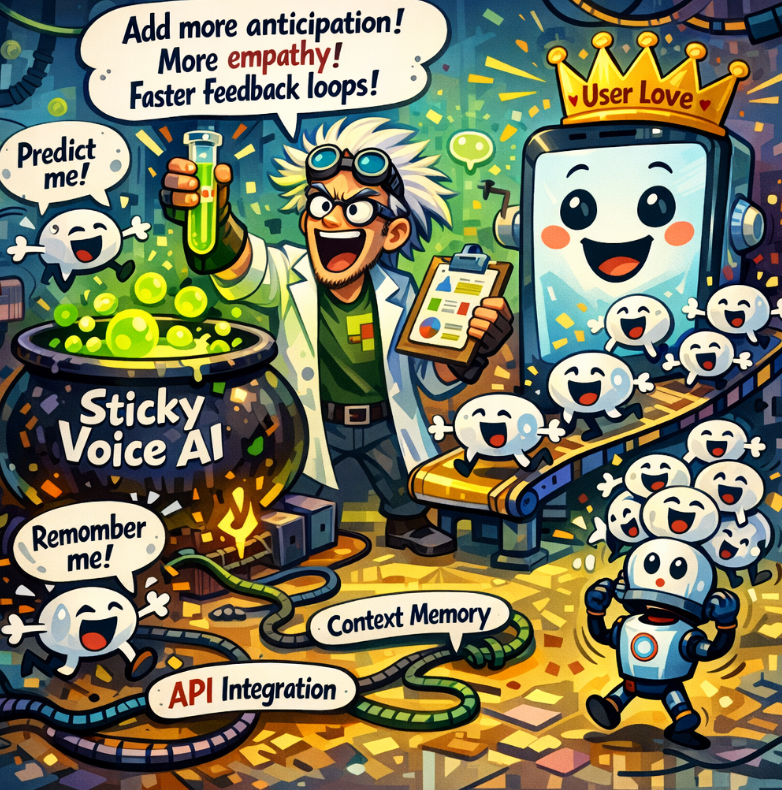
There’s a secret ingredient in the world’s most “sticky” products — the ones users return to not because they have to, but because they want to. It’s not just convenience. It’s not purely novelty. It’s a deeper, almost invisible blend of context, emotion, adaptation, and meaningful anticipation.
Nowhere is this clearer than in Voice AI — where stickiness isn’t earned by flashy commands or clever voices alone, but by features grounded in real science, behavioral cues, and user psychology. When done right, Voice AI doesn’t just respond — it resonates. It becomes not just a tool, but a partner in workflows, decisions, and daily routines.
Let’s explore the product features backed by science that make Voice AI truly sticky — the ones that move it from novelty to necessity.
🧠 1. Predictive Understanding — Anticipation Beats Reaction
Humans don’t just react. We anticipate. We sense, infer, and pre‑maturely prepare. A voice agent that anticipates intent — rather than merely responding to queries — feels almost telepathic.
Scientific principle
Neuroscience shows anticipation triggers dopamine pathways — the same reward circuits involved in motivation and learning. When users feel a system predicts their intent, they reward it with repeat engagement.
Sticky Voice AI features include:
- Next‑turn prediction — suggesting the next likely step before it’s asked
- Behavioral profiling — learning individual patterns over time
- Context history recall — remembering preferences across sessions
When a user asks, “How’s my budget looking?” and the assistant begins with, “You’ve been close to this limit three times this week…” — that feels smart, not just reactive.
🎤 2. Emotional Intelligence — Understanding More Than Words
Text captures words, but voice captures emotion. Humans don’t speak flatly — we speak with tone, pauses, excitement, hesitation these signals tell stories beyond semantics.
Scientific principle
Affective computing — the science of recognizing human emotion — shows that systems that detect and adapt to user sentiment significantly increase engagement and satisfaction.
Features that unlock this:
- Emotion detection layers
- Dynamic response modulation (different replies based on detected mood)
- Empathy triggers (e.g., “I hear that’s frustrating — let’s try another way.”)
Users don’t just want answers — they want understood answers. That’s why emotionally aware Voice AI feels sticky: it reflects us, not just information.
🧩 3. Memory That Matters — Context Over Time
Most AI systems treat each interaction as isolated. Sticky systems treat conversations as continuities — linked narratives, not scattered anecdotes.
Scientific principle
Longterm memory consolidation is key to human recall and attachment. When systems mirror that — by retaining user contexts across time — they build relational stickiness.
Features that enable this:
- Session memory — short‑term conversational context
- Profile memory — long‑term preferences, terminology, style
- Cross‑channel continuity — retaining context across devices and platforms
Instead of repeating preferences every time, sticky Voice AI greets you with:
“Last time we talked about your travel budget — want to pick up where we left off?”
That’s not convenience — that’s continuity.
🔄 4. Adaptive Personalization — Learning With You
Personalization isn’t a tag on functionality — it’s evolution. Sticky voice systems don’t just learn; they adapt.
Scientific principle:
Adaptive systems leverage reinforcement learning and behavioral feedback loops — the science by which organisms adjust habits based on reward and consequence.
Key features:
- Adaptive language models that learn user vocabulary
- Preference shaping based on usage patterns
- Customized brevity and verbosity (some users want concise; others want narrative)
When a system adjusts its responses because of how you speak, how often you ask, and what you value, it becomes less like software and more like your software.
📊 5. Actionable Summaries — From Conversations to Decisions
A voice assistant that merely answers is simply reactive. One that summarizes, synthesizes, and turns speech into decisions becomes indispensable.
Scientific principle:
Cognitive load theory shows humans have limited working memory. A system that reduces cognitive friction — by distilling meaning and surfacing next steps — becomes aligned with how people naturally think and act.
Sticky features include:
- Auto summaries of conversations
- Decision recommendations based on voice patterns
- Task extraction (e.g., “Set a reminder for that deadline.”)
What feels like “magic” is really friction reduction: the system does the thinking so you can act.
🗺️ 6. Seamless Integration — Embedded, Not Bolted On
A voice agent that operates in isolation feels like a gadget. One that is woven into a user’s ecosystem feels like a utility.
Scientific principle:
Distributed cognition theory suggests humans think using tools — as extensions of cognitive processes. When voice agents integrate with calendars, task managers, CRM, or workflows, they become parts of the user’s extended mind.
Sticky integration features:
- Cross‑app triggers (e.g., “Add this to my task list”)
- System orchestration (e.g., triggering workflows)
- Unified context sync across tools
It’s not just voice in a vacuum — its voice in the context of everything the user already does.
🚀 7. Real‑Time Feedback & Iteration — The Conversational Flywheel
Sticky products learn and improve with usage; they never feel “finished.”
Scientific principle:
Cybernetic feedback loops — systems that monitor output and adjust in real time — create self‑reinforcing improvement cycles.
For Voice AI, this translates into features like:
- Real‑time sentiment learning
- Usage pattern refinement
- Error recovery that adapts future responses
Every interaction isn’t just a use — it’s a teaching moment that tunes the system, making it feel progressively smarter.
❤️ 8. Perceived Intelligence — The “That Knows Me” Effect
Here’s the real magic: human brains don’t just reward accuracy — they reward perceived relevance, fluency, empathy, and alignment with intention.
Sticky voice AI:
- feels effortlessly helpful
- speaks the user’s language
- anticipates needs before they’re stated
- reflects emotion and context
This is not random charm; it’s cognitive affinity — when users feel understood, they return.
✨ The Bottom Line
Sticky voice AI isn’t determined by gimmicks or flash.
It’s powered by features rooted in human cognition, behavioral science, and adaptive intelligence:
✔ Predictive understanding
✔ Emotional intelligence
✔ Contextual memory
✔ Adaptive personalization
✔ Actionable summarization
✔ Seamless integration
✔ Real‑time tuning
✔ Perceived intelligence
These are not guesses — they are science‑backed determinants of user engagement and retention.
Voice systems endowed with these capabilities don’t just get used —
they get relied on, trusted, and become part of the user’s lived experience. And in a future where products compete on meaning, not just function, voice AI stickiness isn’t a luxury — it’s a strategic imperative.
