

Why Customers Feel Relief When AI Answers Instead of Humans
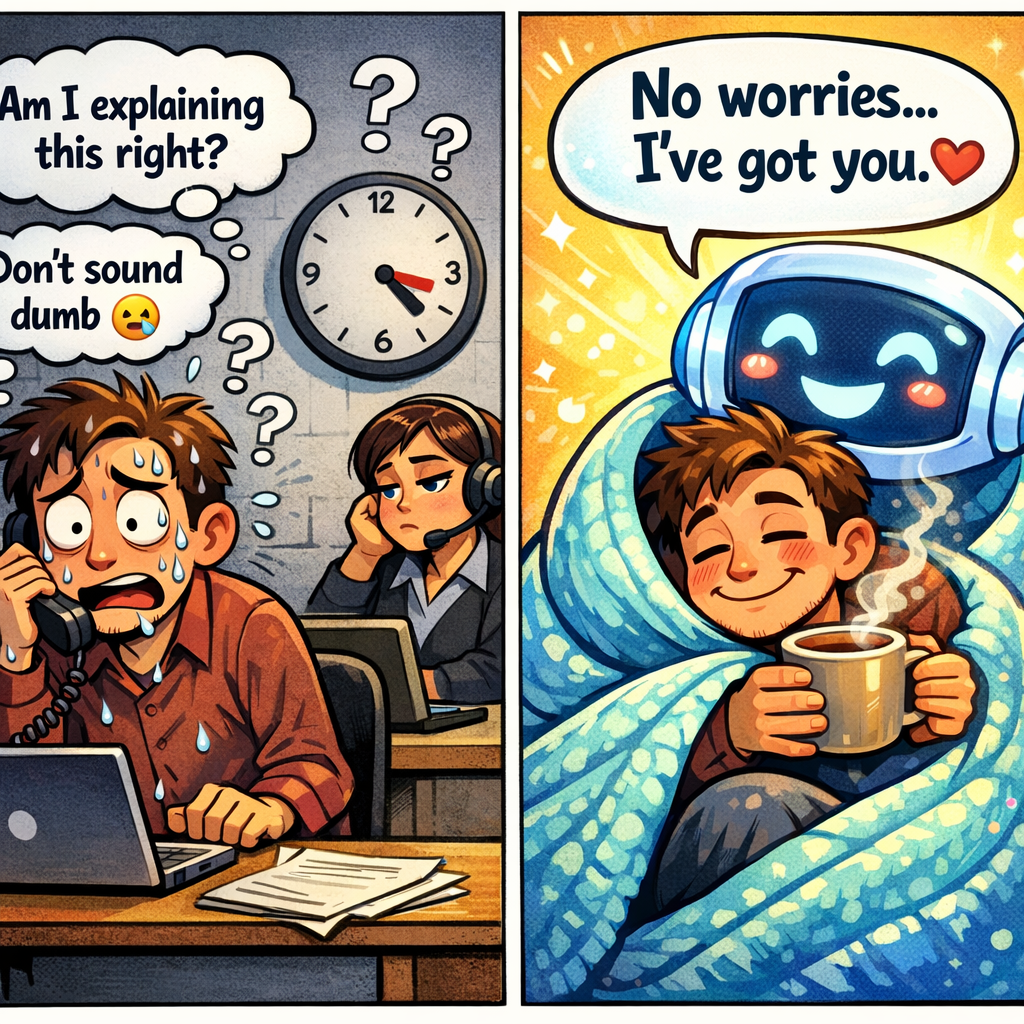
Have you ever watched someone sigh with relief after being answered by a machine?
Not a polite smile.
Not a forced “thank you.”
But a genuine exhale — like the tension in their shoulders suddenly dropped a few inches.
It’s not just curiosity.
It’s not just convenience.
It’s relief.
And that relief is the quiet revolution happening in customer experience — a shift so subtle most companies haven’t even realized it’s occurring.
But customers have.
They’re telling us with their behavior:
They feel safer.
Less judged.
Less exposed.
More understood when AI speaks for the first response — instead of a human.
The Hidden Weight of Human Communication
Human interactions carry something we rarely acknowledge out loud:
Expectation.
Even the friendliest human response comes with invisible pressure:
- “Am I saying the right thing?”
- “Do I sound informed?”
- “Will they think I’m asking a stupid question?”
Every time a customer thinks about speaking to another human, these tiny judgments buzz in the background like static — subtle, persistent, and exhausting.
You don’t see it in metrics.
You feel it in hesitation.
That’s why customers sometimes browse manuals for twenty minutes before they make a simple call. Not because they don’t want answers — but because they fear the social cost of asking for them.
AI Removes the Invisible Audience
Artificial Intelligence doesn’t wear judgment. It doesn’t carry memory of your tone or hesitation. It doesn’t scan your accent or imagine what you should know. It just responds.
Think about what that means:
A customer speaks.
No fear.
No ego threat.
No human expectations.
It’s like talking to a mirror that responds.
Not a judge.
Here’s what happens when that pressure lifts:
Customers speak more freely.
They describe their problems more honestly.
They ask questions they never would have asked a human.
And as a result?
They start to trust the interaction.
Not because AI is perfect.
But because it is safe.
The Psychology of Relief
Let’s dive into the subconscious for a moment.
When a customer hears a human voice on the other side, their brain triggers tiny social defense mechanisms:
- “Did I phrase that correctly?”
- “Will they remember I sounded uncertain?”
- “Should I explain it again?”
These thoughts aren’t rude.
They’re natural human reactions.
But here’s the twist:
When AI speaks instead of a human, those defense mechanisms turn off.
A machine doesn’t carry reputation.
A machine doesn’t perceive tone.
A machine doesn’t evaluate you.
That silence in human judgment is what feels like relief.
Customers go from self-conscious to present — truly present in the conversation.
This kind of psychological ease is not just a UX improvement.
It’s an emotional release.
AI as the Warm Blanket before the Real Conversation
Some might ask:
“Doesn’t human empathy matter more?”
Yes — but not first.
AI isn’t replacing empathy.
It’s preparing for it.
Imagine a customer who’s nervous about asking a question.
They’re unsure.
They’re hesitant.
Maybe even embarrassed.
When AI answers first:
- It normalizes the question
- It reduces fear of judgment
- It makes the next human interaction easier
Customers say things to AI they would never say to a human first — and once the real conversation begins, they’re already unburdened.
AI doesn’t replace the human touch.
It makes the human touch more powerful.
From Relief to Engagement
Here’s what we see happening over and over again:
Before AI:
Customers tiptoe around questions.
They avoid calls.
They wrestle with contact forms.
After AI:
Customers speak clearly.
They engage faster.
They reach solutions sooner.
Not because AI magically knows everything — but because customers feel safe enough to communicate honestly.
Relief isn’t just a feeling.
It’s the engine of engagement.
And once that engine starts humming,
everything changes.
Why This Matters More Than You Think
Most businesses talk about AI in terms of speed, automation, or cost reduction.
But the real story isn’t efficiency.
It’s humanity.
Customers don’t just want answers.
They want to be heard without pressure.
AI doesn’t judge.
AI doesn’t frown.
AI doesn’t think you’re asking a silly question.
It listens with neutrality — a quality that is surprisingly rare in human interaction.
And that’s why it feels so refreshing.
Customers aren’t relieved because the answer is good.
They’re relieved because it was safe to ask in the first place.
The New Role of AI Isn’t Replacement
It’s reassurance.
AI isn’t here to take over human interaction.
It’s here to remove barriers to it.
Once customers feel psychologically safe,
real conversations — and real connections — can begin.
And that’s the real transformation.
Not automation.
Not speed.
Not cost savings. But the relief of being understood without fear
