

Sales Burnout Costs More Than You Think
I first noticed it in the eyes.
Not the tired, glazed look of exhaustion — that’s normal.
I’m talking about the quiet withdrawal, the subtle tightening around the jaw, the way a salesperson’s gaze starts to avoid direct eye contact.
It wasn’t dramatic.
It wasn’t loud.
It was emotional erosion.
Because burnout doesn’t announce itself with fireworks.
It burrows.
It shrinks.
It steals confidence one small fragment at a time.
And when sales burnout hits?
It doesn’t just hurt performance.
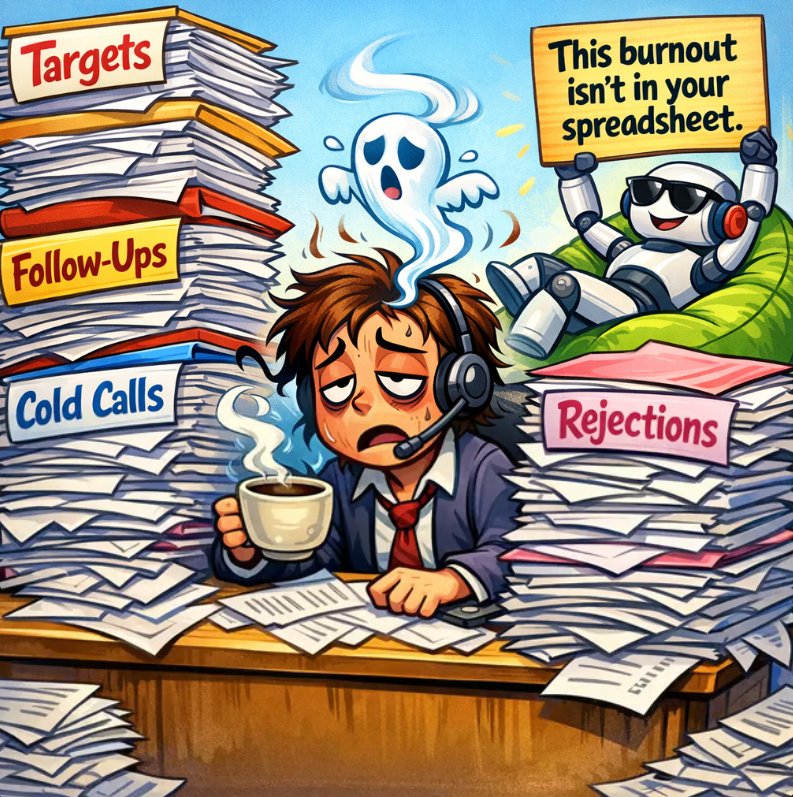
It eats strategy, erodes trust, dissolves morale, and costs far more than any spreadsheet can ever calculate.
This is the unseen cost.
The emotional debt.
The buried loss most companies don’t realize they’re paying.
Burnout Is Not “Tiredness” It’s Emotional Loss
We throw the word burnout around casually — “tight quarter,” “heavy pipeline,” “Q4 grind” — but what we dismiss as stress is often emotional depletion.
Burnout isn’t physical tiredness.
It’s relentless psychological pressure without relief.
Salespeople don’t just talk all day.
They perform.
They manage expectations.
They absorb rejection.
They smile when they want to scream.
They chase yeses while swallowing no after no after no.
You think a “lost deal” is just a number?
It’s a pinch.
A dent.
A blow to confidence.
Over time, those small hits compound.
They stack.
They calcify into something heavier than exhaustion.
Burnout settles in like debt — not catastrophic once, but unrelenting over time.
And here’s the Part Most Leaders Miss
Burnout doesn’t just lower performance.
It distorts human connection.
A burnt-out salesperson:
- listens less deeply
- talks more defensively
- hesitates where they once leaned in
- navigates conversations with caution instead of curiosity
And here’s the kicker:
Customers feel that shift.
Not consciously.
But they feel it.
Because human connection — the spark that turns cold leads into warm relationships — depends on energy, presence, and emotional authenticity.
When those fade, deals don’t just slow down.
They evaporate.
The pipeline doesn’t dry up because of numbers.
It dries up because of human withdrawal.
Burnout Doesn’t Just Hurt Sales — It Hurts the Whole Business
Everyone thinks of burnout as a salesperson’s problem.
But it’s not.
It’s a systemic leak with consequences in every direction:
Marketing loses momentum
Because marketing relies on feedback loops — what’s resonating, what’s landing
Burned-out salespeople stop feeding insight back into strategy.
They stop probing objections.
They stop listening with intention.
Marketing stops learning.
Content loses relevance.
Campaigns grow hollow.
Product development goes blind
Who articulates customer pain points?
Who translates hesitation into roadmap insight?
Sales.
But burnout turns clarity into noise.
Product teams end up building blindfolded.
Customer support becomes firefighting
Salespeople used to set context.
Now they defer.
Customers arrive confused.
Support cleans up the emotional mess.
Burnout doesn’t just shift work.
It shifts emotional cost onto every human interaction downstream.
You Can Measure Burnout in Behavior — Not Just Numbers
Instead of looking at quota attainment alone, look for these quieter signals:
- Shortened responses
- Loss of curiosity
- Reduction in proactive outreach
- More defensive language
- Reduced empathy in follow-ups
These aren’t performance metrics.
They are emotional markers.
Burnout writes itself into language before it writes itself into spreadsheets.
The Cost Most Teams Don’t See: Ego Debt
Every time a salesperson dismisses a lead too quickly,
every time they hedge instead of engage,
every time they repeat a scripted answer instead of listening deeply —
an emotional deduction is made.
Not in revenue.
In confidence.
Sales confidence is capital.
Once depleted, it doesn’t just refill with new leads.
It requires human investment.
Time. Trust. Patience.
Those are the currencies of emotional recovery — and none are cheap.
The Price You Pay When Burnout Becomes Culture
If burnout is left ignored long enough, it stops being an individual problem.
It becomes a norm.
And then:
- Playbooks become defensive.
- Conversations become transactional.
- Empathy becomes optional.
- Curiosity becomes rare.
Instead of active selling,
you get guarded selling.
Instead of proactive engagement,
you get risk avoidance.
Instead of brilliance,
you get procedures.
Burnout doesn’t just reduce output.
It transforms behavior.
And behavior defines culture.
AI and Support Are Not the Enemy — They Are the Balm
This isn’t a call to replace humans with machines.
It’s a call to protect humans from emotional depletion.
When voice AI and intelligent tools relieve repetitive friction,
they don’t just save time.
They save psychological energy.
They take:
- repetitive objections
- early follow-ups
- mundane qualification
- the initial emotional load
…and let human teams focus on what matters most: connection, intuition, empathy, strategy.
AI doesn’t replace salespeople.
It focuses them.
The Real Cost Is Human
When burnout becomes chronic, the price tags we see —
missed numbers, lost deals, high churn —
are just the visible tip of a much larger iceberg.
Underneath lie:
- deferred dreams
- quiet despair
- conversations never had
- potential unexpressed
- confidence silently eroding
Those are the real costs.
Not quotas missed.
Not percentages lost.
But the human energy that never comes back.
The Big Takeaway
Sales burnout isn’t a performance blip.
It’s an emotional erosion.
It doesn’t just lower productivity.
It drains human connection.
It leaks insight.
It distorts culture.
It costs far more than revenue numbers can articulate.
And here’s the most important part:
You don’t solve it with spreadsheets.
You solve it with empathy, strategy, and a profound respect for human emotional energy.
Because the true cost of burnout isn’t in the deals you lose. It’s in the people you never hear from again
